- How Power Influences Creativity by Scott Barry Kaufman, Psychology Today April 2011
- Psychologists ask how well -- or badly -- we remember together, ScienceDaily April 2011
- Singapore’s surprising ‘desired’ education outcomes (including ‘a zest for life’) by Valerie Strauss, The Answer Sheet - The Washington Post April 2011
- Facebook shoots first, ignores questions later; account lock-out attack works (Update X) by Ken Fisher, Ars Technica April 2011
- Women who post lots of photos of themselves on Facebook value appearance, need attention, study finds by Shari Roan, Los Angeles Times March 2011
- Formalizing the Notion of 'Innovation' in an Evolutionary Model by Sanjay Jain, Santa Fe Institute March 2011
- Single Cells to Communities: Understanding the Biology of One Organism at Multiple Scales
- Pigs, Bees, and Elephants: A Comparison of Eight MapReduce Languages by Antonio Piccolboni, Dataspora April 2011
- Why is Chrome so important to Go[[#AviWigdersonogle? It's a 'locked-in user']] by Larry Dignan, ZDNet April 2011
- The Parser that Cracked the MediaWiki Code by Dirk Riehle, Software Research and the Industry May 2011
- Routes et territoires des matières nucléaires, Planète terre France Culture Avril 2011
- WikiLeaks revelations only tip of iceberg, RT May 2011
- Reconstructing the evolution of science and technology from their digital traces by Luis Bettencourt, MDTS March 2011
- Knowledge cartography: representation strategies for the new territories of science by Marco Quaggiotto, MDTS March 2011
- “The Economist” on Innovation and Jobs by Martin Ford, econfuture May 2011
- Une Corée réunifiée, Frontières France Culture May 2011
- How to Build Instant Connections by Ori Brafman, Stanford's Entrepreneurship Corner April 2011
- Intel launches FPGA-equipped Atom by Gareth Halfacree, thinq_ 2010
- Roadmap to AGI by James Albus, BICA 2010
- Marissa Mayer explains Google’s social strategy, skeptical on Facebook by Anthony Ha, VentureBeat
- P3rsp3ctiv3 (Perspective) by Mr. Roboto, Cyberpunk Review May 2011
- Consciousness and Creativity in Brain-Inspired Cognitive Architectures by Włodzisław Duch, CHIST-ERA 2010
- Reach Your Escape Velocity by Geoffrey Moore from Mohr Davidow Ventures, Stanford's Entrepreneurship Corner May 2011
- Why is the belief in global warming affected by temperature? by Art Markman, Psychology Today May 2011
- My Reaction to Osama bin Laden’s Death by Noam Chomsky, Guernica May 2011
- A New Era Of Search Is About The Answers, Not Just The Links by Shashi Seth, TechCrunch May 2011
- The Recursive Mind: The Origins of Human Language, Thought, and Civilization. by Michael C. Corballis, Princeton University Press May 2011
- A New Measure of Centrality for Brain Networks, PLoS ONE 2010
- leverage centrality : extent of connectivity of a node relative to the connectivity of its neighbors.
- note that since, it does not seem to appear often in other publications
- see also
- Network Archaeology: Uncovering Ancient Networks from Present-Day Interactions, PLoS Computational Biology April 2011
- "The ability of these algorithms to reconstruct significant features of a network's history from topology alone further confirms the utility of models of network evolution, suggests an alternative approach to validate growth models, and ultimately reveals that some of the history of a network is encoded in a single snapshot."
- "Non-model-based heuristic reconstructions based solely on degree or centrality can perform well when degree strongly implies age (as is the case for FF and PA random graphs)."
- network growth models
- not necessarily required on a wiki or cvs since history is kept with each change
- check the bibliography of WithoutNotesApril11#TheReconstructionOfSciencePhylogeny to see what inferring framework they are using (if any) beside Matlab
- Wikipedia:Protein–protein interaction
 (PPI)
(PPI)
- The New Science of Network Archaeology, arXiv blog at Technology Review 2010
- How Citation Boosts Promote Scientific Paradigm Shifts and Nobel Prizes, PLoS ONE May 2011
- Unthinking Machines by Stephen Cass, Technology Review May 2011
- LiquidPub Green Paper: lessons learned from the project and recommendations to various stakeholders, May 2011
- The Uniqueness of Human Recursive Thinking by Michael C. Corballis, American Scientist 2007
- motivated by The Recursive Mind by Michael C. Corballis, Princeton University Press May 2011 discovered earlier
- to explore from the references http://psycnet.apa.org/psycinfo/2003-88301-007
- "Center-embedding requires a memory device, such as a stack of pointers, indicating where to pick up the procedure once an embedded constituent has been completed."
- see also the notion of deictic pointers discovered during cognitive sciences classes (cf Cognition) and later on in Supersizing
- mention of Robin Dunbar (famous for Wikipedia:Dunbar's number recently shared during the MBE23)
- hypothesis on religion
- could also be applied to politics in general then
- note that Dunbar's number could also be the limit precisely due to recursion applied to theory of mind
- mention of the Wikipedia:Rouge test
- consider also MemoryLoss
- since it requires understanding of semantic and episodic memory
- but also about a future position of a different self, thus a application of theory of mind
- The Pirate Bay: “The Battle of Internets is About to Begin” by Ernesto, TorrentFreak May 2011
- wondering if TPB and others related websites don't use the a mirrored rhetoric that government use with child pornography. I also think freedom of speech and political material a government might not like or that copyrighted material is often abused, yet that does not make sharing of all material more just.
- Welcome to WikiMaths by Matt Parker, home of hard sums at The Guardian May 2011
- The e-G8 Summit, Unveiled by Nova Spivack, Minding the Planet April 2011
- note that plenary 1 on job creation might contradict the recently read articles by Martin Ford and the tweet by Francois Taddei regarding high-tech software companies getting richer faster AND with less employees
- Movement-produced stimulation in the development of visually guided behavior by Richard Held and Alan Hein, Journal of Comparative and Physiological Psychology 1963
- "[...] findings provide convincing evidence for a developmental process, in at least one higher mammal, which requires for its operation stimulus variation concurrent with and systematically dependent upon self-produced movement."
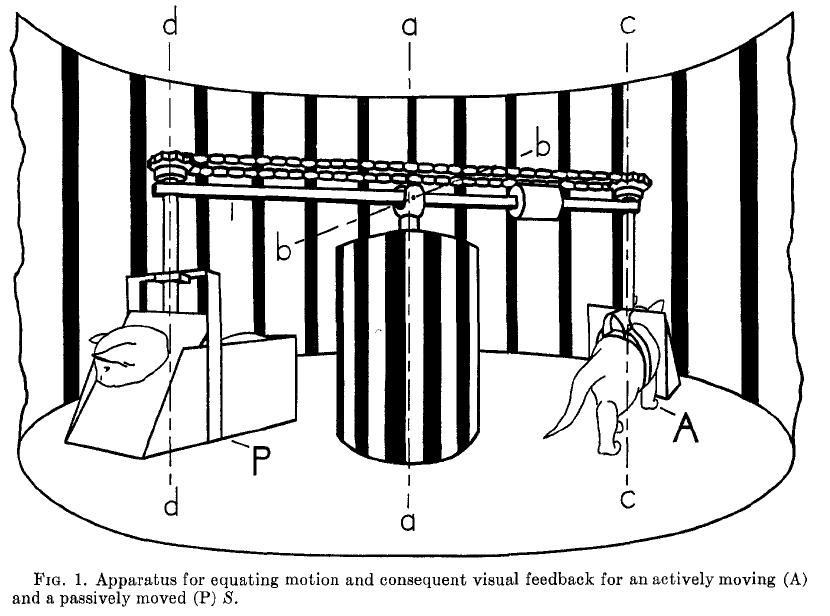
- added before in KeyExperiments#KittenCarousel
- Perception as substitute trial and error by Donald T. Campbell, Psychological Review 1956wcgnm
- mention of William Ross Ashby's book Design for a brain (1954)
- "[a blind subject] may in walking use a blind trial and error of cane movements to search out steps, walls, and doors, reducing the trial-and-error component in his walking."
- consider also the observation I shared with Paola in May 2011 that some machine learning techniques, like gradient descent, seemed to be inspired from the way a blind person would naturally explore its environment to navigate through it
- mention of Wikipedia:Edwin Ray Guthrie, Wikipedia:Norbert Wiener (see in MecaMind) and Wikipedia:Orval Hobart Mowrer regarding cybernetics and learning theory
- mention of the "phylogeny of conscious thought" see web/benetou.fr/fabien/cookbook/phylogenyvisualization.php as potential local visualization
- see also notes on books
- A new evolutionary law by L. Van Valen, Evolutionary Theory 1973
- The Red Queen's Hypothesis paragraph itself starts page 17
- motivated by Newconcepts
- Wikipedia:Artificial intelligence systems integration
- Constructionist Design Methodology (aka CDM), MindMakers 2005
- New Stanford computing lab imagines the mobile-social future by Andrew Myers, Stanford Report May 2011
- Learning to program the D-Wave One by Geordie Rose, Hack the multiverse May 2011
- Thanksgiving Special: D-Wave at MIT by Scott Aaronson, Shtetl-Optimized 2007
- Quantum optimizer a quantum step in the right direction by Chris Lee, ArsTechnica February 2011
- overall being able to distinguish a problem as part of NP might be a key aspect of cognition, one has to be able to evaluate how complex solving the problem should be before economically rationally attempt to solve it
- thus probably have some implication for Mind or OwnConcept#Epistemotaxis? too, making some paths better left unexplored
- or BQP or any other domains the hardware used for cognition might be significantly affected by
- Hopefully my last D-Wave post ever by Scott Aaronson, Shtetl-Optimized 2009
- Learning how the brain does its coding by John Timmer, ArsTechnica May 2011
- Google Lobbies Nevada To Allow Self-Driving Cars by John Markoff, NYTimes.com May 2011
- A Defensive Patent License Proposal by Jason Schultz and Jennifer Urban, Stanford Center for Internet & Society May 2011
- Assange handed Sydney peace medal, AAP via smh.com.au May 2011
- Facebook Busted in Clumsy Smear Attempt on Google by Dan Lyons, The Daily Beast May 2011
- A sufficiently complex simulation of the origins of life by David Deamer, Stanford February 2011
- Siva Vaidhyanathan: We Are Google’s Products, University of California Press Blog May 2011
- video of April 2011
- 1st part, ~6min "We are not Google customers, by no means, we are Google product. Google customers are those advertisers who are buying those very unobtrusive ads that run along the side of every search result page."
- 1st part, ~7min more that product, even "worker bees" through feedback of activity
- 2nd part, ~3min mention of Google as an intermediary thus how the decision on algorithms modify "daily life", see Person#SociallyShapingAlgorithms
- 3rd part, ~3min on finding personal information, it was already public before but harder to find thus more of an "economical" function with a higher cost
- see also 2 months ago WithoutNotesMarch11#SivaVaidhyanathan
- Home Page for Siva Vaidhyanathan, professor of Media Studies at Virginia Law
- http://www.GooglizationOfEverything.com
- SecondMarket, Inc. - A New Vision for Capital Markets by Barry Silbert, Stanford's Entrepreneurship Corner April 2011
- How the brain thinks about the mind: a case study in the neural basis of abstract cognition by Rebecca Saxe, 2010 MIT BCS Special Seminar, MIT TechTV 2010
- End of an era: Microsoft antitrust oversight ends by Nancy Gohring and Grant Gross, CIO May 2011
- Epistemology according to Principia Cybernetica
- Mike Rowe Senate Testimony : Dirty Jobs, Discovery Channel May 2011
- Du discours aux données : vers la fin de la rhétorique ? by Pierre Mounier, InternetActu.net May 2011
- Cartographier le pouvoir, Foucault et Bourdieu by Anders Fogh Jensen and Rasmus Svarre Hansen, March 2011
- The March of Technology by Rodney Brooks and John Hennessy, MIT150 Symposia: Computation and the Transformation of Practically Everything Symposium, MIT TechTV May 2011
- Rodney Brooks on robotics
- ~9min50 the 3rd type of exponential "Someone else is driving an exponential and you get to hop on it for free"
- ~22min mention of uploading
- in reference to a previous talk of the symposium
- regarding the economical and social aspect, see LinkOfTheMonth#February2011 for the work of Martin Ford, Marshall Brain and Robin Hanson
- John Hennessy on energy and computation
- L'informatique comme technologie cognitive by Daniel Memmi, Les Cahiers de l'ISC April 2011
- "Un outil matériel n'aide pas en soi la cognition, mais concevoir, fabriquer et utiliser des outils demande et développe des capacités de conception et de planification." a view probably not shared by Andy Clark (cf Supersizing) who could say that the material tool could itself help cognitive
- mention of Leroi-Gourhan, Vygotsky, Carruthers, Weber, Durkheim, Castells
- no mention of Carr
- Coupled oscillators that synchronize themselves by Steven Strogatz MIT TechTV April 2011
- Social networks that balance themselves by Steven Strogatz, MIT TechTV April 2011
- Aldebaran Robotics To Open Source Code of Nao Robot by Erico Guizzo, IEEE Spectrum May 2011
- Controllability of complex networks, Nature May 2011
- "fundamental questions pertaining to the controllability of complex systems emerging in nature and engineering have resisted advances." sounds coherent with organisms part of an arm race, cf Van Valen 1973's paper A new evolutionary law reader earlier this month
- ND, minimum number of driver nodes, is determined mainly by the degree distribution
- in both real and model systems not the hubs (nodes with high degree) (?!)
- determined mainly by the number of incoming and outgoing links each node has and is independent of where those links point
- small changes in the average degree induce orders-of-magnitude variations
- published there under the cover title "Taming Complexity"
- videos viewed earlier
- consider Internet and the PLoS ONE 2010 article read on Leverage Centrality as A New Measure of Centrality for Brain Networks
- Wikipedia:Matching (graph theory)#Maximum_matchings
- look for related conference in video format
- consider also for the multiple attempts on indexing the wiki with the right amount of balance between control, coverage and computational/cognitive cost
- measure the average time of integration of state of the art in mathematics to other discipline, see if there is a "compressing" trend (i.e. if today the integration is faster than before)
- see also Statistical mechanics of complex networks 2001
- 54 pages review of the field then
- yet another lesson learned from physics statistical systems? (like in graph drawing, optimization, ...)
- funded partly supported by
- questions
- can it be applied recursively to a stack of networks?
- e.g. ExtendedLayeredModel
- or are there prohibitively costly computations between each?
- are those somehow inherent? invariant? recurrent? is there a pattern?
- are those equivalent to ecological niches? making each too costly for non specialized organism to exploit?
- is there an arm-race at work, cf Seedea:Research/Drive
 , between contrallability of others and resilience against being control by others at every level? both at increasing costs thus creating constant new opportunity landscapes?
- if not can the computation at one network serve as the computation (pre-processing or caching rather than simplification) for another?
- is it relevant for semantic? automatic summarization?
- covering
- Albert László Barabási "Bursts", Authors@Google 2010
- Scientific Link-Up Yields ‘Control Panel’ for Networks by Adrian Cho, Science May 2011
- less sexy but very helpful visualization
- control might not be obvious as it could depends on interaction
- e.g. checking that a signal comes from multiple independent sources in a coherent fashion, or through aggregation
- also a dynamic system could include safety mechanisms
- Eric Ries "The Lean Startup", Authors@Google April 2011
- Taking small steps toward personalized search by Greg Linden, Geeking with Greg May 2011
- As time goes by, it gets tougher to remember new information, ScienceDaily May 2011
- Scroogled by Cory Doctorow, Radar magazine 2007
- Workers Leaving the Googleplex by Andrew Norman Wilson, April 2011
- on Google "ScanOps"
- coverage
- The Business Model of Intellectual Ventures by Anders Sundelin, The Business Model Database May 2011
- Alex Osterwalder Authors@Google February 2011
- The Democratization of Entrepreneurship by Steve Blank, Stanford GSB Entrepreneurship Conference March 2011
- An Open letter to Matt Cutts & the Google Web Spam Team, LoveClients May 2011
- Elephants Don't Play Chess by Rodney Brooks, Robotics and Autonomous Systems 1990
- The Faith of the Faithless by Simon Critchley, European Graduate School 2010
- mention of Situationist International (SI)
- ~min15 mention of L'Insurrection qui Vient, read in 2009 (no notes)
- Wikipedia:Simon Critchley
- Simon Critchley page at EGS
- see also Philosophy
- regarding violence and passivity, consider the work of Howard Zinn and You can't be neutral on a moving train
- Tim Wu discusses The Master Switch, Stanford Center for Internet and Society May 2011
- Quasi-Conformally Flat Mapping the Human Cerebellum MICCAI 1999
- "the surface representing the cortical grey matter is topologically equivalent to a two-dimensional sheet"
- related posters
- motivated by WikiBrainMapping
- Case Study: Interacting with Cortical Flat Maps of the Human Brain, IEEE Visualization Conference 2001
- Research Directions for Machine Learning and Algorithms by John Langford, Communications of the ACM May 2011
- Quantitative evaluation of three cortical surface flattening methods, NeuroImage 2005
- A Conceptual Cortical Surface Atlas, PLoS ONE 2009
- Enaction-Based Artificial Intelligence: Toward Co-evolution with Humans in the Loop, Mind & Machines 2009
- mention of several authors I have read (in books Supersizing, TreeOfKnowledge or TheSocietyOfMind and in articles, e.g. Simon or Brooks in this very page) and including few professors I had (Lenay, Stewart)
- defining Enaction-Based Artifical Intelligence aka EBAI
- "Creativity is here defined as the possibility to determine the functions of an undefined element of the environment."
- on meta-adaptation and robotics "[one] could argue that the behavioral creativity of natural organisms is inherited from the adaptation characteristics selected throughout their phylogenesis."
- "coupling causes an own-world to emerge for the user." (mention of umwelt earlier)
- defining "enactive interfaces" through the paragraph "Interface Requirements"
- "entrances and exits [or input/output] are not to be considered as representations of a pre-given world, but as a means of coupling for the cognitive system and the environment."
- "whatever the chosen means of interaction, the essence of virtual reality can be identified as its ability to resist actions, to enable the user to construct meaning."
- close to André Malraux's "On ne s'appuie que sur ce qui résiste."
- "protorepresentations [generated by network of neurons which loop back to themselves with a Q-learning type of algorithm] act as internal epistemic structures which reflect the sensorimotor invariants learnt by experience."
- An Overview of Bing's Newest Facebook Features by Ben Parr, Mashable May 2011
- Culturomics: Quantitative Analysis of Culture Using Millions of Digitized Books by Erez Lieberman Aiden and Jean-Baptiste Michel, Harvard Berkman Center May 2011
- Putting Scientific Information to Work, ISI 1972
- In Oldenburg’s Long Shadow: Librarians, Research Scientists, Publishers, and the Control... by Jean-Claude Guédon, Association of Research Libraries 2001
- "the transmission of scientific information is not the primary concern of journals; branding is."
- "Exploiting inelastic markets wherever they exist (or may be created) is the real name of the capitalist game. "
- defining applied epistemology or epistemological engineering as "organizing and cataloguing roles traditionally exercised by librarians"
- could be interesting to check the software development side of public libraries to see if their own tools are FLOSS, in particular epistemology-oriented software librariesquestion forwarded to Paola's friend who studied archivist/economy at Pisa University
- "if we imagine a situation where e-commerce has really taken off on a large scale, with secured transactions and easy, well-established forms of micro-payments, then the need for libraries as intermediaries might not appear as obvious. Should this dire prediction come to pass, libraries would end up as little more than dusty museums where old books would be stored and old digital files would be periodically refreshed to remain compatible with a fast-evolving technology."
- "Scientific publishers do compete with each other, for example, in trying to attract the winners of Lotka’s race, the Einsteins of the scientific world to their titles; but they also compete by striving to create better visibility for their journal, the idea being to make them move up the pecking order ladder."
- brilliant mention of the panoptic vision by citing Foucaultm, Bentham and Bacon
- "Scientometrics specialists would die to lay their hands on such figures [usage statistics generated by such panopticons]; governmental planners also."
- "The strategic possibilities of such knowledge are simply immense. They resemble the marketing possibilities emerging from the study of consumer habits and profiles."
- mention of Wikipedia:Bradford's law, Eugene Garfield with ISI and Wikipedia:Lotka's law
- lot of publications on the open access movement since then
- Wikipedia:Philosophical Transactions of the Royal Society (Phil. Trans.)
- on the history of intellectual property see InformationFeudalism and TheFutureOfIdeas
- see also Epistemetrics
- regarding the "scientific core" ISI Science Citation Index (SCI), how does eigenfactor.org compare?
- blogs/API/dev tools of private actors
- Springer as they recently provided new tools including Springer Exemplar
- Elsevier
- Thomson Reuters
- is there a list (ideally a visualization in map form) of which actor controls which percentage of the core journals? in which area?
- BrewsterKahleAtLaCantine asked for developpers
- have an online open epistemology laboratory?
- provide curated datasets (CC0)
- provide indicators and the software relying on it (aGPL)
- facilitate exploration through quality interface
- allow for mashups (aGPL)
- display a gallery of visualizations
- check
- explore
- Why you can't really anonymize your data by Pete Warden, O'Reilly Radar May 2011
- L'homme, l'animal et la machine by Georges Chapouthier and Frédéric Kaplan, Culture Académie, France Culture / CNAM May 2011
- ~9min on memory, mnemotechnique objects and its requirement for intelligence, eventually including prediction
- ~18min mmention of the Turing test
- ~22min importance of the environment and body
- ~24min types of consciousness
- consciousness of environment (or of access), consciousness of self (or auto-reflexivity) through the Rouge test
- predictability as a possible measure (idea of a "coupure de predictabilite")
- self-model, see notes on TheEgoTunnel and BeingNoOne
- ~44min mention of curiosity research
- probably done at EPFL or Swiss AI Lab (sort of maximize learning based on minimizing error
- ~53min evolutionary strategy
- ~56min evolution of technology and science at large
- ~75min key aspect of the body including for tests
- including prehension, a la Leroy-Gourhan, but also in the ability to change the environment and build on it and getting the ability to progress through stigmergy
- ~80min no cyborgization process ("sous-cutanne") because of the pace of technology
- even if progresses in bio-interfaces improve enough to do it safely at home?
- explore
- The key trait successful people have, and how to get it by Heidi Grant Halvorson, SmartBlog on Leadership May 2011
- willpower (or discipline) as a display for trust
- Rencontre exeptionnelle entre Richard Stallman et Albert Jacquard, Libre.Accès. May 2011
- Do not let your domain expire with Google Apps, Ben Reyes's posterous May 2011
- Pippi Longstrings by Stefan Marsiske ,~stef/blog/ 2010
- L'homme, l'animal et la machine with Frederic Kaplan, Impatience, Radio Suisse Romande 2011
- Mosaic structures – a working hypothesis for the complexity of living organisms by Georges Chapouthier, E-LOGOS Electronic Journal for Philosophy 2009
- Evolution of complexity in living organisms: mosaic structures by Georges Chapouthier, Complexity, Science and Society 2005
- earlier but rougher draft of the same concept
- Juxtaposition = addition of identical entities
- Integration = modification, or specialisation, of these entities, leading to entities on a higher level which use the previous entities as units
- Charles Darwin on Phylogeny and "Tree-thinking", Talk Reason
- Cybersecurity through Information Theory by Paul Ohm, Jotwell: Cyberlaw May 2011
- Conundrum by Derek E. Bambauer, Brooklyn Law School April 2011
- "Current scholarship, in short, would destroy the Internet in a futile attempt to save it."
- "cyberthreats are likely to target specific information or services on the Internet, rather than the network itself, and there are moderating factors that would restrain at least some attackers."
- "Ted Stevens was, ironically, correct: the Net is a series of tubes."
- "Information is the goal; data that route information to users are best understood as infrastructure."
- "focusing on this question – whether given data counts as information – is precisely the point of this Article‟s approach."
- Information-Based Theory
- Positive Access (ensure authorized access)
- Negative Access (prevent unauthorized access)
- Positive Alteration (ensure authorized changes)
- Negative Alteration (prevent unauthorized changes)
- "There is little benefit to launching a fruitless attack. Thus, inefficiency improves the positive aspects of cybersecurity."
- suggestion sounds close to the recently discovered LOCKSS Lots of Copies Keep Stuff Safe
- author added to Censorship#SeeAlso
- on SCADA see Bypassing#SCADA
- see Internet and ToDo#OptimizationSafetyMaintenance, also Seedea:Utopiahanalysis/Botnets
- consider how the information theory paradigm could better fit with my own view
- @dbambauer
- http://internet.bambauers.com
- shared to Philippe Langlois
- Lingodroid Robots Invent Their Own Spoken Language by Evan Ackerman, IEEE Spectrum May 2011
- Alfred North Whitehead : sciences modernes et philosophie antique by Bertrand Saint-Sernin, Canal Academie May 2011
- Supercooperators: The mathematics of evolution, altruism and human behaviour by Martin Nowak, RSA May 2011
- NASA Advanced Supercomputing (NAS)
- ESA Software Systems Division
- Impossible by Étienne Ghys, Images des mathématiques May 2011
- La précognition est-elle démontrée ? by Avner Bar-Hen, Images des mathématiques April 2011
- Signals in Social Supernets by Judith Donath, Journal of Computer-Mediated Communication 2007
- see TheRedQueen#Chapter5 The Peacock's Tale and TheMatingMind#Chapter4 mentioning Veblen's goods
- "Being in fashion—whether via physical clothing or online linking—signals fitness in the continuously changing information world. It signals status in a society where "information prowess"—i.e., having access to information, the ability (often termed taste) to distinguish between good and bad information, and the willingness to adapt to the changes brought by new information—is a fundamental part of the culture."
- "if the information itself is the end (as it is with "useful" information), making access easier is beneficial. When information is used to signal status, as it is with fashion, then making access easier accelerates the race, rather than increasing efficiency"
- Comment Flow 2007
- author comment flow in collaboration with Dietmar Offenhuber
- previous mention of Everett Rogers on innovation diffusion in TheMythsOfInnovation#Chapter4
- Amotz Zahavi for his 1977 article The cost of honesty
- The Unreasonable Effectiveness of Data by Peter Norvig, UBC Department of Computer Science's Distinguished Lecture Series 2010
- Visualization and Interaction Research at MSR by Mary Czerwinski, UBC Department of Computer Science's Distinguished Lecture Series January 2011
- Cartographier les connaissances scientifiques by Raphaël Velt, Knowtex Blog May 2011
- John Palfrey on The Digital Public Library of America Beta Sprint, May 2011
- A Digital Library Race, and Playing Catch-Up by Natasa Singer, NYTimes.com January 2011
- Evolutionary biology: The origins of novelty by Armin P. Moczek, Nature May 2011
- Gap in Understanding by Hans Rosling, European Zeitgeist May 2011
- Unified Theory by Stephen Hawking, European Zeitgeist May 2011
- Large-scale Data Analysis Using the App Engine Pipeline API by Brett Slatkin, Google I/O May 2011
- Why Google Hasn’t Implemented A ‘Do Not Track’ Feature by Joe Mullin, paidContent May 2011
- Analogy as the Core of Cognition by Douglas R. Hofstadter, Presidential Lecture, Stanford 2006
- default reaction with anything new, art, startups, etc
- e.g. "it's like X but with y!", "it's the Z or q!"
- see his IAmAStrangeLoop
- Extras by Douglas R. Hofstadter
- Douglas Hofstadter at the Cognitive Science Department of Indiana University
- Is the Death of Intel Research a Harbinger of Doom for Privately-Funded Technology Research? by Christopher Mims, Technology Review May 2011
- Location Based App development using Google APIs, Google I/O May 2011
- especially interesting regarding WheelShare
- see also
- Social Allostasis: Anticipatory Regulation of the Internal Milieu by Jay Schulkin, Frontiers in Evolutionary Neuroscience January 2011
- allostatic regulation as "physiology of change, emphasizes longer-term anticipatory, and feedforward systems."
- information molecules as "e.g. oxytocin, prolactin, vasopressin, corticotrophin hormone [,...] cortisol, CRH [,...] bombesin" and what they code for
- "Behavioral adaptation and regulation is a fundamental way in which physiology viability is maintained; allostatic regulation emphasizes regulatory flexibility and cephalic expansion."
- reviewing previously coined terms: heterostasis, predictive homeostasis, rheostasis, homeorhesis
- "Physiological cognitive systems are oriented to the social milieu."
- "Cortisol is important in the conversion of short to longer-term memory"
- motivated by finding Wikipedia:Allostasis and Wikipedia:Allostatic load after reading TheTinkerersAccomplice
- Jay Schulkin's profile at the enter for the Brain Basis of Cognition (CBBC), Georgetown University
- France lobbies G8 for Internet control and censorship by Cory Doctorow, Boing Boing May 2011
- Coffeescript supersedes Rails by Ben Nolan, April 2011
- JavaScript: The Good Parts by Doug Crockford, Google Tech Talks 2009
- La coopération spontanée a besoin d'espaces d'échanges simplifiés, L'Atelier: Disruptive innovation January 2011
- Data Mining Map by Saed Sayad, 2010
- Corporate Rule of Cyberspace by Slavoj Žižek, Inside Higher Ed May 2011
- Software Updates: Courgette - How Courgette works, The Chromium Projects
- C++ at Google: Here Be Dragons, LLVM Project Blog May 2011
- The Virtual Lab by Duncan Watts, Science Board Symposium, Santa Fe Institute April 2011
- OpenCog Recap – March to May 2011 by Joel Pitt, OpenCog Brainwave May 2011
- Prosocial Preferences and the Evolution of Behavior Within and Between Groups by Jeremy Van Cleve, Science Board Symposium, Santa Fe Institute April 2011
- Children learn language in moments of insight, not gradually through repeated exposure, study shows ScienceDaily May 2011
- How Companies Are Using Data from Foursquare by Carine Carmy, Technology Review May 2011
- Facebook Places API by Fred Fang, Social App Workshop Oct 2010
- Crockford on JavaScript: A Public Lecture Series at Yahoo!
- FLOSS Weekly 146: Tiki Wiki CMS Groupware with Marc Laporte, 2010
- most built-in features (as opposed to PmWiki minimalist architecture)
- major releases every 6months
- all in all, more like a KM distribution?
- WikiSecrets: The inside story of Bradley Manning, Julian Assange and the largest intelligence breach in U.S. history, FRONTLINE PBS May 2011
- Utopie universitaire by Luc Allemand, le blog des livres de La Recherche May 2011
- Integrative Levels Classification (ILC)
- Physical One-Way Functions, Science 2002
- Building Data Start-Ups: Fast, Big, and Focused by Michael E. Driscoll O’Reilly Strata Online May 2011
- China used prisoners in lucrative internet gaming work by Danny Vincent, Guardian.co.uk May 2011
- UPDATED: Google Exec Says It's A Good Idea: Open The Index And Speed Up The Internet by Tom Foremski, SiliconValleyWatcher 2010
- When the Internet Thinks It Knows You by Eli Pariser, NYTimes.com May 2011
- Computer Science in the Information Age Part by John Hopcroft, 2009
- Taming complexity by Albert-László Barabási, Nature Physics 2005
- Scientists capture the first image of memories being made, PhysOrg 2009
- Filters that reduce 'brain clutter' identified, MedicalXPress April 2011
- Strength of Response Suppression to Distracter Stimuli Determines Attentional-Filtering Performance in Primate Prefrontal Neurons, Neuron April 2011
- dlPFC as DorsoLaterlal PreFrontalCortex
- Elections and Strategic Voting by Eric S. Maskin, Institute for Advanced Study May 2011
- On Chomsky and the Two Cultures of Statistical Learning by Peter Norvig, May 2011notified about the typo which he promptly fixed
- Tracking brain states under general anesthesia by using global coherence analysis, PNAS May 2011
- Being Barbie: The Size of One’s Own Body Determines the Perceived Size of the World, PLoS ONE May 2011
- Consciousness: What, How, and Why by Michael J. Proulx, Science May 2011
- A Logical Use for Atoms, Science May 2011
- The Periodic Table of Videos, Science May 2011
- The Apache Software Foundation Announces Apache Libcloud as a Top-Level Project The Apache Software Foundation Blog May 2011
- Information is Protophysical by Douglas J. Matzke, PhysComp 1996
- Is Information Physical or is Physics Informational by Charles Bennett 2005
- mention of Chaitin 1975
- seems not to be available as recording, yet audio available
- Is Information Physical?, Perimeter Institute for Theoretical Physics 2011
- Man's best friends: How animals made us human by Pat Shipman, New Scientist May 2011
- "The human-animal link offers a causal connection that makes sense of tree of the most important leaps in our development:
- the invention of stone tools,
- the origin of language and
- the domestication of animals."
- Mind readers: Eavesdropping on your inner voice by Duncan Graham-Rowe, New Scientist May 2011
- The prison of our beliefs and how to escape it by Amanda Gefter, New Scientist May 2011
- my own attempt at managing my Beliefs more properly
- Inside the Human Body: Building Your Brain, BBC May 2011
- Teaching Artificial Intelligences using Quantum Computers by Suzanne Gildert, Hack the multiverse May 2011
- D-Wave Systems sells its first Quantum Computing System to Lockheed Martin Corporation, D-Wave Systems May 2011
- Occupancy Grids and Emergent Search Behavior for NPCs by Alex J. Champandard, AiGameDev.com April 2011
- The Mechanics of Influence Mapping: Representation, Algorithm & Parameters by Alex J. Champandard, AiGameDev.com May 2011
- Pavlov’s AI – What did it mean? Suzanne Gildert, Physics and cake January 2011
- "It seems that being intelligent enough to start modifying your own reward mechanisms is not necessarily a good thing!"
- one could wonder why for the computer its own survival, or maintainance, is not enough of a reward and one that can not be "cheated" since it requires resources
- IBM100: Memories of Benoit Mandelbrot by Michael Frame, Quicksilver Minds May 2011
- blog of IBM Research at Almaden center
- Notre attention est-elle maîtrisable ?, Science publique, France Culture May 2011
- mention of the cognitive cost of decision (mostly frontal areas) and its automatic switch to real-time processing (mostly reflex and at the back of the brain) for situation that requires it (e.g. stress)
- thus the importance of delegation
- mention of the precedence of motivation for attention
- ~34min mention of task switching and its performance impact
- ~37min on "lacher-prise" to maximize fluidity on well-trained gestures
- allows to avoid intensive local error-checking but rather better take into account the environment
- ~42min application of "lacher-prise" to creativity
- ~43min on mastering the attention of others and for their own benefits
- ~53min on exercises, e.g. Meditation
- see earlier article on WithoutNotesMay11#dlPFC
- see also Cognition#GoalFocusAttention in particular comparing Wikipedia:Dorsal attention network (DAN) and Wikipedia:Ventral attention network (VAN)
- see CognitiveEnvironments using Greasemonkey#VirtualBlinders
- Computation in Nature and the Nature of Computation by Cristopher Moore and Stephanie Forrest, SFI Science Board Symposium 2009
- Avi Wigderson's Talks
- Lecture III: Cryptography: secrets and lies, knowledge and trust of Louis Clark Vanuxem Lectures - A world view through the computational lens by Avi Wigderson, Princeton University 2007
- only browsed through the Powerpoint for the slide 12 on "Nature’s one-way functions: 2nd law of Thermodynamics"
- cf also his previous talk at IAS WithoutNotesJanuary10#AviWigderson with a definition of P/NP related to creativity
- US military contractors hacked – possible link with RSA SecurID breach, reports claim by Graham Cluley, Naked Security May 2011
- Did the US write Stuxnet? Deputy Defense Secretary won’t deny it by Graham Cluley, Naked Security May 2011
- PHP Development with MongoDB by Fitz Agard, MongoNYC 2010
- Twitter unmasks anonymous British user in landmark legal battle Nigel Green and Josh Halliday, Guardian.co.uk May 2011
- Astronomers Unveil Most Complete 3-D Map of Local Universe, Harvard-Smithsonian Center for Astronomy May 2011
- 75 Years of Computer Science by by Lance Fortnow, Computational Complexity May 2011
- Soul Dust: the magic of consciousness by Nicholas Humphrey, The study of cognition & culture today lecture series, LSE February 2011
- overall based on the principle of abstracting initially primitive physical sensations
- and "tagging" more complex concepts
- hence the related interest of ImprovingPIM?
- ~13min on its purpose "Conciousness is theater, it changes our outlook on life. 'Its job is to change our outlook on life."
- ~17min expressing doubt on the neural-correlate of consciousness or NCC
- ~21min on internalization as keeping track but without expressing, a progressive privatizing process
- consider OwnConcepts#Cryptocognition and Seedea:Research/Drive
- then "creating the potential for re-entrant feedback loop"
- yet this could have been done before through modification of the environment, but probably at a higher price and slower pace
- see also Mind on the energy/economical aspect
- ~27min mention of Hofstadter
- ~72min during Q&A clarifying it is a physical view of the world thus of consciousness, yet the experienced phenomenon "gives the illusion of being immaterial, out of this world"
- possibly due to Mind as itself perpetually trying to be the most energy efficient mechanism possible too
- yet if this is a bias
- what are its benefits? local coherence, low dependency, private, ...
- its down sides? limited in size, hard to share, ...
- review read ealier this month WithoutNotesMay11#MichaelProulx in Science
- Soul Dust: The Magic of Consciousness by Nicholas Humphrey, Princeton University Press 2011
- Wikipedia:Nicholas Humphrey
- PowerPoint presentation on official Soul Dust: the magic of consciousness LSE Events page
- No X-aggeration by John Allen Paulos, Scientific American June 2011
- Living in a Quantum World by Vlatko Vedral, Scientific American June 2011
- A Test for Consciousness by Christof Koch and Giulio Tononi, Scientific American June 2011
- Consciousness as Integrated Information: a Provisional Manifesto by Giulio Tononi, The Biological Bulletin 2008
- "it has been suggested, from a different perspective, that information may be, in an ontological sense, prior to conventional physical properties (the it from bit perspective; Wheeler and Ford, 1998). This may well be true but, according to the IIT, only if one substitutes "integrated information" for information."
- Φ as

- Wikipedia:Kullback–Leibler divergence aka information divergence, information gain, relative entropy or KLIC and notated
||
- is there an updated table of Φ value per brain area? current top 5 of such an index?
- is there a correlation between modern brain areas (e.g. neocortex) and high Φ?
- can it be viewed as a form of self-coupling? recursive-coupling? yet without being monolithic?
- is it a measurement that can be applied to a piece of software? to this wiki? to this wiki with its content? (thus added to the existing
?action=GroupStats)
- could the metric be used to automatically generate the association between content and related areas for WikiBrainMapping?
- could it be used as a quality metric to approximate equivalent value to that of a brain?
- does it share properties with ND, minimum number of driver nodes and thus degree distribution as seen before in WithoutNotesMay11#TamingComplexity?
- can it be thought of as the expressive power of a synthesized system? how many propositions can a system generate thought a single entry-point?
- note that the recurrent expression of "attaining higher level of consciousness" might have a measurable and less mystical meaning
- to explore
- Why would (otherwise intelligent) scholars believe in "Religion"? by Pascal Boyer, Pascal's blog at international cognitive and culture institute February 2011
- Theology and cognitive science by Helen De Cruz, Helen De Cruz's blog at international cognitive and culture institute May 2011
- mention of the program at University of Oxford discovered before
- Phi by Peter Hankins, Conscious Entities 2010
- The Consciousness Meter by Peter Hankins, Conscious Entities 2010
- Interview with John Wheeler 2008
- Visual Rhetoric, LSE Research May 2011
- Stavroula Tsirogianni at the Methodology Institute
- thesis "Social Values in Context: A Study of the European Knowledge Society"
- Vlad - Petre Glăveanu at the Institute of Social Psychology
- thesis "Towards a cultural psychology of creativity: The case of Easter-egg painting in urban and rural Romania"
- MA Graphic Moving Image, London College of Communication (LCC)
- Ego Depletion—Is It All in Your Head? Implicit Theories About Willpower Affect Self-Regulation, Psychological Science 2010
- The Tale of One-way Functions by Leonid A. Levin, Problems of Information Transmission 2003
- Bitcoin: A Peer-to-Peer Electronic Cash System by Satoshi Nakamoto
- More is Different by P.W. Anderson, Science 1972
- "one may array the sciences roughly linearly in a hierarchy,
according to the idea: The elementary entities of science X obey the laws of science Y.
| x | y |
|---|
| solid state or many-body physics | elementary particle physics |
| chemistry | many-body physics |
| molecular biology | chemistry |
| cell biology | molecular biology |
| ... | ... |
| psychology | physiology |
| social sciences | psychology |
- But this hierarchy does not imply that science X is "just applied Y."
- Relative Entropy by Sergio Verdu, NIPS 2009
- Les accidents vasculaires cérébraux (1), Avec ou sans rendez-vous, France Culture May 2011
- Animal connection: New hypothesis for human evolution and human nature, ScienceDaily 2010
- The Animal Connection and Human Evolution by Pat Shipman, Current Anthropology 2010
- domesticating more precisely called cross-specie alloparenting
- "the real advantage of animal domestication is using animals as living tools that also provide valuable renewable resources."
- "Transferring the concept of tool making and tool using from inanimate stone or wood to live animals was a fundamental advance in human evolution predicated on knowledge of biology, ecology, physiology, temperament, and intelligence of target species; of the selective breeding; and of communication techniques based on the animal connection."
- could AGI be the "new pet" to domesticate and boost our cognitive abilities?
- Anon & Anthropology of Hacking by Kambiz Kamrani, Anthropology.net February 2011
- Pour l'OMS, le téléphone portable est peut-être "cancérogène", LeMonde.fr May 2011
- The Anthropology of Hackers by Gabriella Coleman, The Atlantic 2010
- Geek Politics and Anonymous by Gabriella Coleman, re:publica XI April 2011
<< April11 | Back to the list of months | June11 >>
 Fabien Benetou's PIM