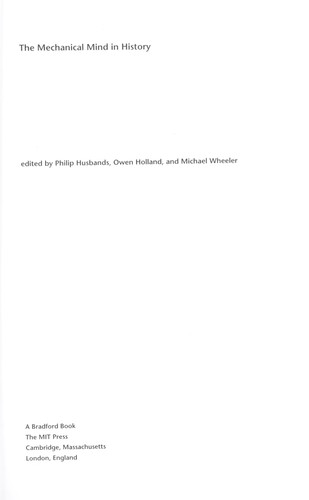
The Mechanical Mind in History by Philip Husbands, Owen Holland and Michael Wheeler - ISBN 0262083779 - MIT Press 2008
note that this was finished much earlier but without recall, recall starts a month before the current date to already start with very spaced recalls
Motivation
Mechanistic view of the world including cognitive, cf MyBeliefs, and wanting to clarify it, especially against dualist arguments.
Pre-reading model
Draw a schema (using PmGraphViz or another solution) of the situation of the area in the studied domain before having read the book.
Pre-reading
- Ideally I should methodically (cf my visual methodical reading poster)
- propose my own view before reading the book
- improve it based on the articles by adding references and arguments
- write my arguments against the views when they contradict but that I can demonstrate my rational is founded by being coherent and having matching data
- What do I expect from the book?
- Improve my human model on cognition to
- improve my own quality of thinking
- facilitate the embodiment of thinking in software thus providing better cognitive support as embedded tools designing internet websites/SaaS
- Clarify questions on
- Is our brain and it's resulting thinking process intrinsically, by nature, mechanistic (and thus potentially predictable)?
- Is it becoming so because of all our mechanical apparatus and thus becoming a self-fulling prophecy?
- How can propose experiments to determine if those are idealizations or realistic models?
- What are the pattern is this history of thinking, the evolution of "this mechanical mind", and thus what can potential futures can we expect?
- Consequently, how could one prepare for those potential futures?
- How did I find it?
- After doing some research on the history of computation (videos of Phun addition/subtraction then the Babbage engine cf cognitive tools evolution
 )
)
- What am I especially interested in and why?
- 7 From Mechanisms of Adaptation to Intelligence Amplifiers
- Discovering the paper on Asbhy Intelligence Amplification as opposed to independent artificial intelligence based on the concept of "neo-neo-cortex" (personal idea local work? during 05/2008)
- 11 The Mechanization of Art
- Work on Seedea and the management of ideas
- more generally based on an incremental and thus evolutionist understanding of today's situation thus through history
Reading
Note : page numbering refers to the electronic version, 11 pages more than the paper numbering (i.e. page 44 refers to page 33 on paper)
- Introduction: The Mechanical Mind Explore by Philip Husbands, Michael Wheeler, and Owen Holland
- explores the purpose of the book
- not GAI vs AI vs *AI
- but historical construction of the hardware and software computations including the needs and ideals shared by people working on those solutions
- a paragraph for each following chapter
- a short ironic ending on the speculative "church of NBIC" and the potential lessons to learn from our past
- Charles Babbage and the Emergence of Automated Reason by Seth Bullock
- a work and discovery within (and potentially thus thanks to) a context
- the necessity to automatize computation, especially logarithm, based on the pressure of intense automation of labor of the industrial revolution
- growing societal concerns regarding the automation of reasoning fostered by the field of natural theology (decades before Darwin's On the Origin of Species)
- published as Ninth Bridgewater Treatise as a response to critics regarding a mechanist view
- at that time Babbage was one of the very few to be able to carry out research thanks to computation models
- existing important debate over geological record's and the potential role of a deity as a mean to explain "the inexplicable"
- Babbage consequently proposed a "computation model" that would fit the data (thus providing the equivalent of running a simulation)
- the simulation would itself produce the discontinuity without the need of any intervention
- based on a stable and understandable general law or "program"
- he demonstrated its validity in print but also by carrying out the calculations
- Darwin was informed of this demonstrations by Charles Lyell (leading geologist at that time)
- providing Darwin with ‘‘an analogue for the origin of species by natural law without divine intervention’’
- by his experiment, Babbage propose that unexpected irregularities in a phenomenon do no reject the possibility of a model
- a current similar view is punctuated equilibrium by Gould/Eldredge
- nonlinearity once again does not reject the possibility of a model but ask to refine it
- Babbage's thinking process allowed him to rely on usage of his method to demonstrate difficult cases
- The Temple of Serapis from Lyell’s Principles of Geology being an example of such a a capability
- facilitate the usage of large amount of computations required to make a demonstration using tables
- distinguishing between two different usages
- provide a computational model as methodical thinking process
- automate computations to produce information
- already, the usage or precises tables is possible thanks to the division of mathematical labor, an early form of human-based distributed computing
- "strongly influenced by Baron Gaspard De Prony’s work on massive decimal tables in France from 1792"
- we can see that as early as 1792 the division of labor, including cognitive labor, has been envisioned and put into practice for efficiency and reducing costs (p41)
- Menebrea discussed to witch point this automation could go and what the limits would be and suggesting that only only basic cognition functions could be automatized
- Venn stated that only the treatment of prepared information could be automatized unlike gathering of data, formalize the process to compute them and interpret them could not
- Stanley Jevons (1835–1882) and Alfred Marshall (1842–1924) pursued to apply those recent techniques including the work of Venn and Boole to economics
- Jevons working so "that the logical consequences of known states of affairs could be generated efficiently"
- Marshall continuing his work but to go beyond "mere calculation" adding exploratory behavior
- proposing a form of evolutionary algorithm as early as 1860 (p44)
- raising the question of understandability and to witch extent such automatically produced result could hinder the learning mechanism of its users
- D’Arcy Thompson: A Grandfather of A-Life1 by Margaret A. Boden
- On Growth and Form published in 1917, a biological perspective as a starting point
- highly acclaimed but hardly practicable by the lack of computational tools, limited by then current technical feasibility
- Cavendish's fish demonstration try to simulate life by reproducing its mechanisms, not by looking at a living organism or learning from it as (bio)mimetics does
- A-Life is "seeking its logical-computational principles", it is an abstract discipline by nature
- searching for the "pure" mathematical aspect of nature and growth
- in 1787 Goethe suggest a "logic" of life derived from his work on plant metamorphosis (p58)
- but within a framework of "aesthetic", the beauty of efficiency based on needs
- thus being nearly opposed to analytical deconstruction of smaller parts but to quickly be eclipsed by Darwin's work
- Alan Turing’s Mind Machines by Donald Michie
- explores the principle of the halting problem (derived from Hilbert's work and the Entscheidungsproblem) and the universal turning machine
- displaying "intelligence" as an improvement to the initial program
- he expected that such behavior would become possible "As soon as one can provide a reasonably large memory capacity"
- combinatorial solutions did not seem to bother him
- concludes on the growing explanatory problem and the "seemingly irreducible opacity"
- What Did Alan Turing Mean by ‘‘Machine’’? by Andrew Hodges
- The Ratio Club: A Hub of British Cybernetics by Philip Husbands and Owen Holland
- starting now, page number comes from the paper edition
- (p91)
- From Mechanisms of Adaptation to Intelligence Amplifiers, The Philosophy of W. Ross Ashby by Peter M. Asaro
- Gordon Pask and His Maverick Machines by Jon Bird and Ezequiel A. Di Paolo
- Santiago Dreaming by Andy Beckett
- Steps Toward the Synthetic Method, Symbolic Information Processing and Self-Organizing Systems in Early Artificial Intelligence Modeling by Roberto Cordeschi
- The Mechanization of Art by Paul Brown
- The Robot Story: Why Robots Were Born and How They Grew Up by Jana Horáková and Jozef Kelemen
- God's Machines: Descartes on the Mechanization of Mind by Michael Wheeler
- Why Heideggerian AI Failed and How Fixing It Would Require Making It More Heideggerian by Hubert L. Dreyfus
- An Interview with John Maynard Smith
- An Interview with John Holland
- An Interview with Oliver Selfridge
- An Interview with Horace Barlow
- An Interview with Jack Cowan
See also
Overall remarks and questions
Synthesis
So in the end, it was about X and was based on Y.
Critics
Point A, B and C are debatable because of e, f and j.
Vocabulary
(:new_vocabulary_start:)
mainstays
exemplifying
fourscore
quibbles
glee
slog
(:new_vocabulary_end:)
Post-reading model
Draw a schema (using PmGraphViz or another solution) of the situation of the area in the studied domain after having read the book. Link it to the pre-reading model and align the two to help easy comparison.
Categories
Back to the Menu
Other read books linking to the The Mechanical Mind in History page :
Back to the Menu
 Fabien Benetou's PIM