Principle
- Writing notes cost literally nothing (paper and computer space are both free)
- Time is the most precious asset
- free vs most precious thing = stop wasting your precious time and the time of your friends, write notes down.
On The Menu :
Content I am currently studying
| Priority | Title | Position | Notes | current page | chapter | last time read |
| ? | OpenGovernment | [?---------] | notes | p71/432 | ch5/34 | 28/08/10 |
| ? | MainstreamAndFormalEpistemology | [?---------] | notes | p150/200 | ch9/9 | 01/09/11 |
| ? | 3DNegotiation | [?---------] | notes | p20/999 | ch2/99 | 15/11/10 |
| ? | EvolutionaryDynamics | [?---------] | notes | p9/384 | ch2/14 | 19/10/09 |
| ? | Influence | [?---------] | notes | p1/336 | ch1/7 | 15/05/11 |
| ? | ProgrammingCollectiveIntelligence | [?---------] | notes | p26/368 | ch2/12 | 01/05/11 |
| ? | SpaceTechnologies | [?---------] | notes | p75/554 | ch4/21 | 11/11/09 |
| ? | DesignInspiredInnovation | [?---------] | notes | p91/280 | ch4/7 | 15/08/11 |
| ? | ArtificialIntelligenceAModernApproach | [?---------] | notes | p396/1152 | ch10/25 | 15/18/11 |
| ? | TheHumanBrainColoringBook | [?---------] | notes | p5-18/301 | ch5/9 | 24/03/11 |
| ? | ProvingDarwin | [?---------] | notes | p20/144 | ch2/8 | 11/11/11 |
| ? | RaceAgainstTheMachine | [?---------] | notes | p20/76 | ch2/1 | 11/11/11 |
| ? | TheLightsInTheTunnel | [?---------] | notes | p262/262 | ch5/5 | 29/05/12 |
| ? | TheWillpowerInstinct | [?---------] | notes | p20/999 | ch2/99 | 11/11/11 |
| ? | Sushi | [?---------] | notes | p20/999 | ch2/99 | 11/11/11 |
| ? | WhyInternetPornMatters | [?---------] | notes | p20/152 | ch2/8 | 11/11/11 |
| ? | TheGoldenTicket | [?---------] | notes | p20/188 | ch2/10 | 11/11/11 |
| ? | TheEvolutionOfGod | [?---------] | notes | p20/999 | ch2/99 | 11/11/11 |
| ? | PermutationCity | [?---------] | notes | p20/999 | ch2/99 | 11/11/11 |
| ? | ProbablyApproximatelyCorrect | [?---------] | notes | p20/999 | ch2/99 | 11/11/11 |
| ? | ComputationalCreativityResearchTowardsCreativeMachines | [?---------] | notes | p20/406 | ch2/19 | 11/11/11 |
| ? | DesigningVirtualRealitySystems | [?---------] | notes | p20/233 | ch2/11 | 11/11/11 |
| ? | SmarterThanYouThink | [?---------] | notes | p20/999 | ch2/99 | 11/11/11 |
| ? | LeCodeDeLaConscience | [?---------] | notes | p20/397 | ch2/7 | 11/11/11 |
| ? | Machinamenta | [?---------] | notes | p20/192 | ch2/7 | 11/11/11 |
| ? | Sapiens | [?---------] | notes | p20/443 | ch2/99 | 11/11/11 |
| ? | TheScienceOfManagingOurDigitalStuff | [?---------] | notes | p32/275 | ch1/12 | 7/21/19 |
| ? | TheCaseAgainstReality | [?---------] | notes | p20/272 | ch2/10 | 11/11/11 |
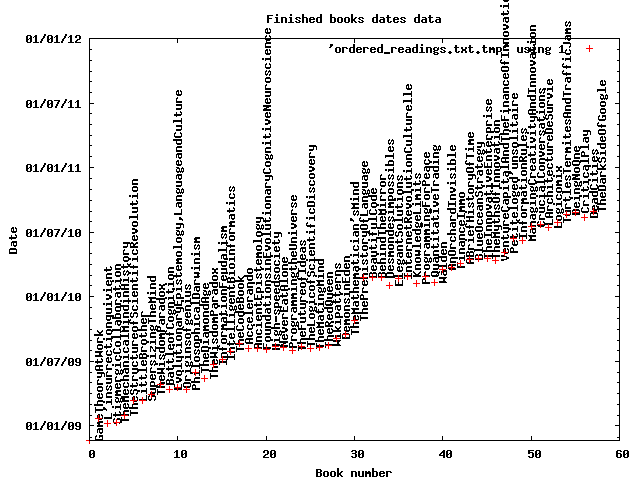
Finished
All books are not necessarily there, in particular books read in paper format. Finished books should be added to Google My Library (consider instead own Sphinxsearch) for later search with Keywords#inmybooks.
Consider the yearly overview.
This should instead be the pagelist inverse of
See also ThePhycisist's BookLog started on the same principal (might required a password)
Content finished recently without notes
Those are kept for reference for potential future discussion or writing.
To do
Check the complete listing started early 2009
Content I am currently scanning
Those are books that might read later on.
- The Economics of Creativity: Ideas, Firms and Markets edited by Thierry Burger-Helmchen, Routledge January 2013
- motivated by the thought that economical constraints are key to artificial creativity
- the same way that availability of resources matter in biological evolution
- Feeling Beauty : The Neuroscience of Aesthetic Experience by G. Gabrielle Starr, The MIT Press 2013
The Happiness of Pursuit by Shimon Edelman, Basic Books 2012
- Epistemology of the Cell: A Systems Perspective on Biological Knowledge by Edward R. Dougherty and Michael L. Bittner, Wiley-IEEE Press August 2011
- The Origins of Evolutionary Innovations: A Theory of Transformative Change in Living Systems by Andreas Wagner, Oxford University Press September 2011
- Nature of Computation by Cristopher Moore and Stephan Mertens, Oxford University Press 2011
- Information Arts: Intersections of Art, Science, and Technology by Stephen Wilson MIT Press/Leonardo Books 2002
- Code/Space - Software and Everyday Life by Rob Kitchin and Martin Dodge, The MIT Press March 2011
...
Check the complete listing to see content that discarded and the associated reasons.
Content I am interested in
L'argent, l'urgence Louise Debrusses (second reading)
- Le Point - Les textes fondamentaux de la pensee francaise
Little Brother by Cory Doctorow, 2008
Histoire des codes secrets (Original title : The Code Book) by Simon Singh, 1999
- The Computational Beauty of Nature: Computer Explorations of Fractals, Chaos, Complex Systems, and Adaptation: Gary William Flake: Books by Gary William Flake
The Things We Do Using the Lessons of Bernard and Darwin to Understand the What, How, and Why of Our Behavior, Gary Cziko, 2000
- Knowing Knowledge (Online low resolution version)
- On Getting Creative Ideas by Murray Gell-Mann, 2007
- Videos lectures of the six keynote speakers, Neuroinformatics 2008
- An Orchard Invisible, A Natural History of Seeds by Jonathan Silvertown (to be published in April 2009)
- The Science of Fear: Why We Fear the Things We Shouldn't--and Put Ourselves in Greater Danger, Daniel Gardner, Dutton Adult 2008
- Outgrowing the Earth: The Food Security Challenge in an Age of Falling Water Tables and Rising Temperatures by Lester R. Brown, 2004
- Matrix, machine philosophique, Éditions Ellipses 2003
What Engineers Know and How They Know It: Analytical Studies from Aeronautical History (Johns Hopkins Studies in the History of Technology) by Walter G. Vincenti, 1990
- The Revolution Will Not Be Funded published by South End Press, 2007
- Advertising and Society Readings 2008 by Patricia Pakvis
- The Great Equations: Breakthroughs in Science from Pythagoras to Heisenberg by Robert P. Crease, 2009
- History of Computation Course Notes by Paul E. Dunne
- Institute For Pure and Applied Mathematics (IPAM) past programs from UCLA
- ICWSM 2009 - International AAAI Conference on Weblogs and Social Media San Jose
- Catalogue Mathématiques dans la section Sciences fondamentales sur Canal-U
Sciences cognitives et modèles de la pensée de Brigitte CHAMAK, Canal-U 2002
- L'anneau fractal de l'art à l'art à travers la géométrie, la finance et les sciences de Benoît MANDELBROT, Canal-U 2000
Connaissances et pensée mathématiques (les bases cérébrales de l'intuition numérique) de Stanislas DEHAENE, Canal-U 2000
Les nombres et l'écriture de Jim RITTER, Canal-U 2000
Natural Geometry by Elizabeth S. Spelke (Harvard), June 2009
Processus conscients vs. non-conscients / Conscious and non-conscious processing, Stanislas DEHAENE, Canal-U 2007
Les mathématiques de l'évolution Régis FERRIERE, Canal-U 2002
- Mathematics, Philosophy, and the "Real World" by Judith V. Grabiner
Mathematics from the Visual World by Michael Starbird
PS : read content is displayed like this
New content / Sources
Personalized recommendation engines
And in general Recked: A Night of Recommendation Technologies held in January 2009
- SuggestRSS RSS Suggestions Based on Similarity (currently offline)
- Toluu sharing the feeds you read and discovering new ones.
Feeds
Ebooks
Friends
Produced content
Sharing refined content
To do
- Should I only add what Im using on what I tried and dislike or what I should try?
- Ex : Digg could be added to "General recommendation engines"
- EX : StumbleUpon could be added to "Personalized recommendation engines"
- Study how AGPL tools (Wish list and actual list) could fit in the picture
- Integrate personal research on Personal Internet Memory alias PIM
- Try Tarpipe: Simplify Your Social Media Workflow by Frederic Lardinois by ReadWriteWeb November 10, 2008
- Don't forget what "cannot be seen" including filters (rinse feed, adblock, ...)
- Based on my previous work on personal information flow/steam :
- Template :

- Example :

- add more suggestion engines
- add more serendipity engines (!)
- copy the large blocks and put them in other page for potential inclusion
- eventually trim them thanks to the line restriction
- xFruits Compose your information system
- change the Content I am currently studying/Finished to an automated system
- PageList + Category
- synthesize the page to PTVs and use it in MyLibrary system
 Fabien Benetou's PIM