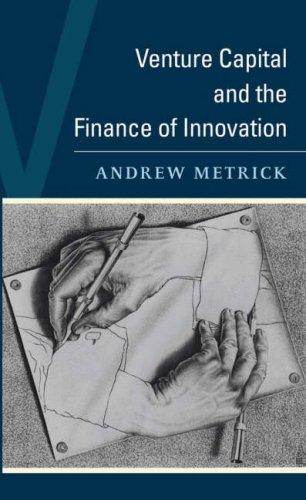
Venture Capital and the Finance of Innovation by Andrew Metrick - ISBN 0470074280 - Wiley 2007
Motivation
Working on innovation (cf Seedea:Research/Research ) and how it can become financially sustainable (cf FinancialTools) then book recommended by Sylvain (probably motivated himself by his SubMate experience and his presentation at ESSEC).
Pre-reading model
Family, friends, banks (10K) -> BusinessAngel (100K) -> VC (1M) -> corporation acquisition exit
Reading
- Preface : A Reader's Guide
- detailing why VCs don't necessarily focus on financial methods yet why it matters
- "This book takes the perspective of a venture capitalist - not an entrepreneur." (p.x)
- "This book is attempting to provide a bridge between the language of VC and the language of finance" (p.xi)
Part I: VC Basics
- 1 The VC Industry
- distringuishing VCs and angels as the 2nd are investing their own money instead of managing a portfolio thanks to the money of other investors, resulting in a different behavior (p4)
- Center for Venture Research Whittemore School of Business & Economics, University of New Hampshire
- "Because of the need to exit, VCs avoid investments in <<lifestyle>> businesses (companies that might provide a good income to the entrepreneurs, but have little opportunity for a sale or IPO)." (p5)
- the exit requirement pushes VCs to invest mainly in small business that will become large companies (to become public) in a short period of time (under ~7 years)
- this leading to investment in hi-tech and specific industries which provide such characteristics
- "VC activities can be broken into three main groups :
- investing,
- monitoring and
- exiting" (p9)
- section on the History of VC
- excellent summary (p20)
- 2 VC Players
- where do VCs' GPs get the money from LPs and in what proportions
- how do they use it spread in their associated VC funds
- management fees (~2.5% per year) and carried interests (~20% of all fund profits)
- but limited by clawbacks and covenants
- summary (p40)
- 3 VC Returns
- Sand Hill Econometrics Tools for Private Equity
- Wharton Research Data Services
- LPs - gatekeeper (e.g. Cambridge Associates) - GPs
- gatekeepers thus have an interesting position to generate statistics
- mention of the survivor bias database analyze, like QuantitativeTrading did
- "The IRR is an answer to the question <<how well did you do with my money while you had it>> Many investors would like to get the answer to a different question, which asks, "Overall, how much money did you make for me?>>" (p54-55)
- key terms defined including investment multiple (and its multiple names)
- 4 The Cost Of Venture Capital
- "The main driver of the cost of capital is the trade-off between risk and return." (p65)
- Wikipedia:Capital asset pricing model
 (CPAM)
- "The higher the β, the higher the expected return." (p67)
- present in Google Finance
- banana bird example on diversification (p69 to 74)
- "the main driver of financial risk is covariance" (p74)
- "If you don't pay someone an extra return to accept the risk from you, then she will not accept it. This is the intuition behind measuring risk with the CAPM beta." (p74)
- Wikipedia:Fama–French three-factor model (FFM)
- Pastor-Stambauch model (PSM)
- 5 The Best VCs
- "even if reputation worth nothing else, it enables VCs to get cheaper prices and more acceptances for their offers." (p83)
- analysis of the "supply side" of capital and the "demand side" for capital
- "even these [sucessful] VCs recognize that most of what they do is not scalable, and there are limits to the number of investments that they can make." (p85)
- listing the top-tier firm in order to be able to study their strategies
- brief discussion about the Wikipedia:Sand Hill Road aggregation phenomenum (p87-88)
- top-tier venture capitalists
- A Accel Partners, Benchmark Capital, Charles River Ventures, Kleiner, Perkins, Caufield %26 Byers, Matrix Partners, Sequoia Capital
- B Alta Partners, Apax Partners, Austin Ventures, Battery Ventures, Draper Fisher Jurvetson, New Enterprise Associates, Sevin Rosen Funds, Summit Partners, Technology Crossover Ventures
- Amount Invested in Venture Capital by Region, Created in 2009 on Many Eyes
- 6 VC Around The World
- mainly an analysis on why the rest of the world is lagging behind the US
- proposed reasons are exits, the entrepreunarial ecosystem, law and corporate governance, country risk, cultural differences
- considering also the network effect, how a small difference can ripple through
Part II: Total Valuation
- 7 The Analysis Of VC Investments
- revised curves on the nature (acquired, IPO, defunct, still private) of portofolios over time (10 years)
- study of the step by step investment process screening, term sheet, due diligence, closing
- "the typical VC would need t screen at least 100 companies to make one investment." (p135)
- two key assesments
- market size
- ability of the management team
- 8 Term Sheets
- "the big picture is that a term sheet describes the basic structure of a transaction and provides a set of protections against expropriation." (p146)
- 9 Preferred Stock
- "key to understand how these protections work, if only to know the relative bargaining positions for various investors" (p177)
- Redeemable preferred (RP)
- Convertible preferred (CP)
- Participating CP (PCP)
- PCP with cap (PCPC)
- 10 The VC Method
- key elements of the VC method (p192)
- focus on the value of the company at the time of a successful exit high target return reflecting the significant probability of failure
- accounting for a reduction the current ownership percentage because of later rounds of investment
- investment recommendation
- 11 Discounted-Cash-Flow Analysis Of Growth Companies
- first method to estimate the exit value, key input in VC valuation
- modeling the life-cycle in 3 parts
- venture period
- rapid-growth period
- stable-growth period
- use key cash flows, NPV (Net Present Value) and industry average cost of capital
- 12 Comparables Analysis
- mentioning the risk of relying too much on this type of estimation while using current and past data
Part III: Partial Valuation
Part IV: The Finance Of Innovation
See also
- FinancialTools
- Seedea:Seedea/SandIdeabox#StartUpAnalysis
- my presentation MBE02#IntroductionVentureCapital during MBE 2nd session
- Instructor Companion Site, Wiley
- Andrew Metrick Yale School of Management
- The Metrix 2006
- Professor Andrew Metrick makes a valiant attempt to get a venture capital job for a Wharton MBA with no previous VC experience.
- reviews
- NBER Publications by Andrew Metrick starting from 1996
- Why VC's avoid innovation, and how to use them safely by Andy Singleton, Assembla blog February 2010
- Why Venture Capitalists Avoid Innovation: They Like Making Money guest post from Andy Singleton, OnStartups.com February 2010
- Why we don’t want VC or Angel money SagePoint Software November 2009
- "or any business, and particularly for a services business (and SaaS is a services business), you should serve only one master: your customers. Once investors are involved, there is now another master to serve. These two masters want different things out of you"
- Content Tagged with Venture Capital Investopedia
- SVBFinancialGroup's Channel
- VC Industry Overview, National Venture Capital Association (NVCA)
- Visualizing the Structure of Venture Capital Co-Investments by Drew Conway, Zero Intelligence Agents November 2009
- OnBioVC Your Source for BioScience Venture Capital Data
- How Venture Capital Works, SVB Financial Group January 2010
- The State of Venture Capital, SVB Financial Group January 2010
- CrunchBase, especially its companies directory
- SSTI State Venture Capital Dashboard State Venture Capital Investment Data from SSTI and the PWC Moneytree Report
- Everything I Didn't Learn About Startups As A VC (Or Why VCs Make Lousy Entrepreneurs) by Charlie O'Donnell, BusinessInsider.com March 2010
- How Much Venture Capital Should You Raise For Your SaaS Venture? by Bernard Lunn, ReadWriteStart February 2010
- Why Entrepreneurs Don't Need VCs Saad Khan, Forbes.com April 2010
- Decoding The Brain Of A VC by Vishal Gondal, God in Chief April 2010
- Teaching Videos at Entrepreneurship and Venture Capital Research Centre
Overall remarks and questions
- When should VC be avoided? How?
- Can you have FIY (Fund It Yourself) innovation?
- Since VC firms are well known, especially top-tiers, is it possible to get information from their portfolio to study trends?
Synthesis
So in the end, it was about X and was based on Y.
Critics
Point A, B and C are debatable because of e, f and j.
Vocabulary
(:new_vocabulary_start:)
Mezzanine Financing
Bridge Financing
(:new_vocabulary_end:)
Post-reading model
Draw a schema (using PmGraphViz or another solution) of the situation of the area in the studied domain after having read the book. Link it to the pre-reading model and align the two to help easy comparison.
Categories
Back to the Menu
Other read books linking to the VentureCapitalAndTheFinanceOfInnovation page :
Back to the Menu
 Fabien Benetou's PIM