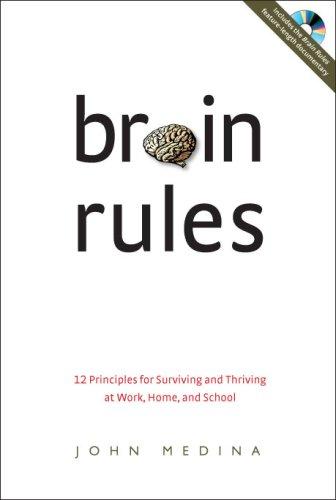
Brain Rules
Brain Rules: 12 Principles for Surviving and Thriving at Work, Home, and School by John Medina - ISBN 0979777704 - Pear Press 2008
Motivation
Describe in a sentences or two what motivated me to read this book.
Pre-reading model
Draw a schema (using PmGraphViz or another solution) of the situation of the area in the studied domain before having read the book.
Reading
- Rule #1 Exercise boosts brain power
- my Exercises page with weekly reminders
- check is Exercises and PersonalInformationStream are correlated
- Rule #2 The human brain evolved, too
- see FECN+MecaMind
- Wikipedia:Triune brain
- mention of Wikipedia:Theory of mind
or , as discovered during SC02
- on the cooperation, see Wikipedia:The Evolution of Cooperation
and Wikipedia:Game theory
- Rule #3 Every brain is wired differently
- my own requirements for Cognition#WikiBrainMapping and ObjectsExoBrain
- see also LImagerieCerebraleDansTousSesEtats
- on IQ (p63) see my IntelligenceQuotient page
- Rule #4 We don’t pay attention to boring things
- mention of Gun, Gems and Stell (p75), cf LinkOfTheMonth
- regarding Posner's Trinity Model (Wikipedia:Attentional shift#Three_stages_of_attention_orientingand
attention (p78), see Cognition#GoalFocusAttention including links on the attention networks
- "Try creating an interruption-free zone during the day" (p93) cf CognitiveEnvironments and Cognition#DedicatedCreativityTime
- see also the split focus: multitasking at M.I.T., FRONTLINE: digital nation, PBS 2010
- Rule #5 Repeat to remember
- metaphor of door handles close to Wikipedia:Affordance
(p114)
- according to Learning science : Actively recalling information from memory beats elaborate study methods, ScienceDaily January 2011 it could be "Retrieve to remember"
- added to Cognition#DailyExercisesFeed
- metaphor of door handles close to Wikipedia:Affordance
- Rule #6 Remember to repeat
- see also my MemoryRecipe
- Rule #7 Sleep well, think well
- see Health#Sleep
- Rule #8 Stressed brains don’t learn the same way
- mention of Wikipedia:Learned helplessness
- previously discovered while watching a video related to InformationRules
- difference between rate stress and chronic stress
- e.g. in the workplace
- mention of Wikipedia:Learned helplessness
- Rule #9 Stimulate more of the senses
- chapter read while listening to Jamie XX remixes
- Wikipedia:Involuntary memory
- Proust's Wikipedia:In Search of Lost Time
- note on olfactory sensory specificity of bypassing the thalamus
- Rule #10 Vision trumps all other senses
- cf earlier discovered table on senses bandwidth (in MB/s)
- see also the work of Varela, cf TreeOfKnowledge
- Donald Duck in MathMagic Land, Walt Disney Pictures 1959
- Rule #11 Male and female brains are different
- ?
- Rule #12 We are powerful and natural explorers
- mention of Wikipedia:Mirror neurons
(p269)
- mention of Wikipedia:Mirror neurons
See also
- Cognition.Cognition
- Cookbook.Cognition
- previously read books
- BrainRules.net Brain development for parents, teachers and business leaders
- Brain Rules for Presenters Garr Reynolds
- http://www.youtube.com/user/brainrulesbook
- John Medina, Authors@Google 2008
- http://quiz.thefullwiki.org/ on the book itself, key topics and the authors
- links to videos on growth cone and other, cf LinkOfTheMonth and http://fabien.benetou.fr/PersonalInformationStream/WithoutNotes overall
- Your Brain at Work by David Rock
- LImagerieCerebraleDansTousSesEtats at ICM
- John Medina, the Ruby on Rails Podcast 2008
- John Medina (Conclusion) the Ruby on Rails Podcast 2008
Overall remarks and questions
- chapters tend to be opened by pathological case, thus showing that the "average" behavior, even if expected, is not the sole behavior
- consequently showing how useful the correct is
- also showing what related problems could be avoided
- chapters also open on ideas and suggestion for decision makers, in particular for the education system overall but also the workplace
- multiple metaphors of software as pre-established brain circuitry
Synthesis
So in the end, it was about X and was based on Y.
Critics
Point A, B and C are debatable because of e, f and j.
Vocabulary
(:new_vocabulary_start:) new_word (:new_vocabulary_end:)
Post-reading model
Draw a schema (using PmGraphViz or another solution) of the situation of the area in the studied domain after having read the book. Link it to the pre-reading model and align the two to help easy comparison.
Categories
Back to the Menu
CONTENT
CONTACT
UPDATES
LAST TWEET


RSS for this page only