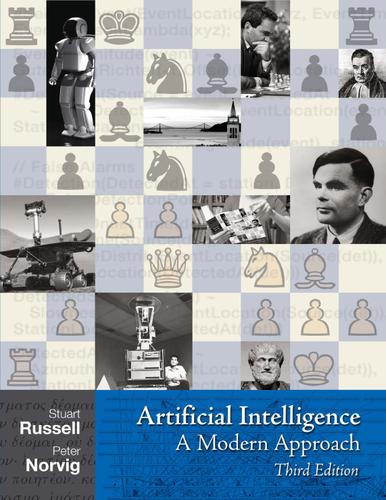
Artificial Intelligence: A Modern Approach by Stuart Russell and Peter Norvig - ISBN 0136042597 - Prentice Hall 2009 (3rd Ed.)
Motivation
Recommended by several persons including J-M Vanel, also required for AIClass.
Pre-reading model
List the main decisions that should be impacted by reading the book in order to estimate the Seedea:Content/Newconcepts#InformationActionRatio and facilitate rule design as suggested after finishing TheTinkerersAccomplice.
Draw a schema (using PmGraphViz or another solution) of the situation of the area in the studied domain before having read the book.
Reading
starting at chapter 2, PDF page number = book number+20) 79 127 173 209 247 294 333 377 413 450 487 522 571 623 656 704 777 817 845 873 902 938 985 1030 1060
Part I Artificial Intelligence
- 1 Introduction
- add the seminal Lisp article I read in Berkeley, important for the history of AI
- brief mention of AGI
- 2 Intelligent Agents
Part II Problem Solving
- 3 Solving Problems by Searching
- 4 Beyond Classical Search
- 5 Adversarial Search
- 6 Constraint Satisfaction Problems
Part III Knowledge and Reasoning
- 7 Logical Agents
- 8 First-Order Logic
- 9 Inference in First-Order Logic
- 10 Classical Planning
- 11 Planning and Acting in the Real World
- same motivation than from the previous chapter
- 12 Knowledge Representation
Part IV Uncertain Knowledge and Reasoning
- 13 Quantifying Uncertainty
- 14 Probabilistic Reasoning
- 15 Probabilistic Reasoning over Time
- 16 Making Simple Decisions
- 17 Making Complex Decisions
Part V Learning
- 18 Learning from Examples
- 19 Knowledge in Learning
- 20 Learning Probabilistic Models
- 21 Reinforcement Learning
Part VII Communicating, Perceiving, and Acting
- 22 Natural Language Processing
- 23 Natural Language for Communication
- 24 Perception
- 25 Robotics
Part VIII Conclusions
- 26 Philosophical Foundations
- 27 AI: The Present and Future
See also
Overall remarks and questions
Synthesis
So in the end, it was about X and was based on Y.
Critics
Point A, B and C are debatable because of e, f and j.
Vocabulary
(:new_vocabulary_start:)
new_word
(:new_vocabulary_end:)
Post-reading model
Draw a schema (using PmGraphViz or another solution) of the situation of the area in the studied domain after having read the book. Link it to the pre-reading model and align the two to help easy comparison.
Categories
Back to the Menu
Other read books linking to the ArtificialIntelligenceAModernApproach page :
Back to the Menu
 Fabien Benetou's PIM