Principle
Many tools from research in social networking have emerged recently we must benefit from them, especially since our networks have grown a lot and if we want to be scalable and have quality relationships we won't be able to go further without coping tools (again).
Applications
- improve caller-ID
- display contextual information about the caller
- provide a VoIP version
- use the "Contact" section of wiki pages to automatically include the potential persons interested
- bottom and up limit
- privatization system
- from the more specialized (perfectly matching tag) to the more general (anybody)
- go pass beyond the Dunbar's number while maintaining high quality relationships
- leveraging social models (e.g. Six degrees of separation
 ) and mediated digitalized conversations (SNS, Google Wave, VoIP, ...)
- explore the notion of "social routing"
- applying and visualization models of sociology
Note that being social has a cost (energy, resources, ...) and that maintaining ones network might also be seen with a (non financial) return on investment mindset in order to avoid extremes in both direction (asocial or ultra-social/eusocial).
Potential solution
- Person.Template used to add another person
- generated network
- PageLists to list persons
(:pagelist group=Person list=normal name=-Person,-*Template*:)
- PageListTemplates to make GraphViz code
- PmGraphViz to generate the image and display it
Note that the wiki format provide natively support for history of each page, potentially way to study the "history of a relationship"
Result
(:pmgraphviz -- [=
   digraph {
      me [label="me" style=filled fillcolor=blue];
      Person.Test1 [label="Person.Test1" style=filled fillcolor=orange];
      me -> Person.Test1;
   }
=] :)
See actually the local implementation (more secure since we are dealing with actual private information).
Check Processing for improved visualization.
Remarks
- Could family fatigue, meeting family members not for pleasure but because they are related, be a consequence of predictability? Could the low information exchange lead to gradually unpleasant encounters?
- note that this also happens with long-term close acquaintances but to a lesser degree
- risks
- increasing predictability
- social pressure
- conflict avoidance
- advantages
- no small talk required
- known domain of agreements
- solutions
- find personal topics in which the other person has specific knowledge that is interesting to you
- unique trips for geography, family heritage and culture, youth and history, ...
- introduce new topics and activities
- leverage own skills the other person believe are unique to himself or herself for your own problem
- offer to do the opposite but never force it, let the person take your offer later on if preferred
- see also
- Teamwork as offloaded cognition for the initiator of the project
- is it not just delegating by laziness or for efficiency but a solution to solve complexity through scalability
- also, without delegating, could simply the presence within a specialized environment, for example a research laboratory, very efficiently facilitate the conduct of complex work by asking questions to other members and letting them play with those questions in the background of their mind lower the stress on each participant?
- inspired by N is a Number on Paul Erdos, The Mechanical Mind in History and Les Prodigieux Theoremes De Monsieur Nash in which each brilliant work was closer to vision and orchestration of the work to reach it rather than solely tedious attempts
- see also http://127.0.0.1/wiki/Collaborations/Collaborations
- topology of the current social group, dynamics and their consequences
- 1 to 1 conversation
- exchange, dialog, absence of the audience, no possibility to hide, ...
- many to many conversation
- about "winning", having an audience, demonstrating alpha-type qualities, ...
Done
To do
- use Seedea:Oimp/Socialannotating

- define default network (email, IM, IRC, Twitter, ...) to transmit a message
- per user
- per type of message (texte, picture, ...)
- per content (personnal, professional, ...)
- as a composition of the 3
- consider adding a password (or .htaccess limited to 127.0.0.1)
- find an API for importing data from social networks
- embed/update data on pages
- stats from irssi logs (IRC, IM through bitlbee/minbif, Twitter through twirssi, VoIP through Asterisk), Facebook, Twitter, ...
- people you are connected to
- frequency of msg exchanged
- date of last message sent
- qdos and its applications

- schema that shows what counts are made for the various supported sites
- rdf
- output a visual through PmGraphViz
- check The Friend of a Friend (FOAF) project "creating a Web of machine-readable pages describing people, the links between them and the things they create and do" and its potential usage
- my own FOAF thanks to identi.ca
- see also the active wiki
- see the related discussion at PIM (2009-10-09T16:12:18)
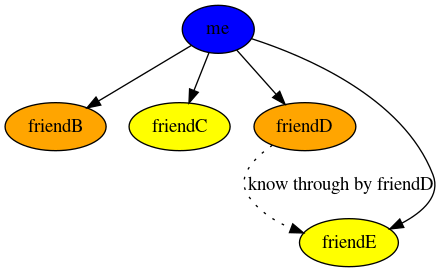
distance represents frequencies of messages exchange
color type or last message sent
- link to the social aspect of Cookbook.Cognition#Thinking
- add Content.Needs and use categories to automatically select the person most likely to be able to help
- example House.House#Contacts
- imagine this as a "distributed/social cognition API"
- consider a resume (formalized as XML resume) an equivalent of API definition or WSDL)
- integrate my irssi /note
/alias note trigger add -once -privmsgs -masks '$0*' -command 'echo -level hilight -window &bitlbee $0 -> $1-'
- make note read/write in the wiki instead, letting me modify information outside of irssi
- trust systems
- Reputation management according to Wikipedia
- "the process of tracking an entity's actions and other entities' opinions about those actions; reporting on those actions and opinions; and reacting to that report creating a feedback loop."
- existing commercially inspired
- apply the same to each interactions with an equivalent FOSS framework/library
- examples in related communities
- research in multi-agent system (MAS) and contract negotiation
- brief work in 2007 on MAS and collaboration by contract
E:\Work\Co-Evolution\Prototype\architecture.ppt
- On Social Reasoning in Multi-Agent Systems by Jaime Simao Sichman and Yves Demazeau, 2001
- "In our context, such a mechanism entails that agents must explicitly represent, exploit and revise certain properties concerning the other agents [in order to infer some new beliefs from the current ones]."(p1)
- especially in regard to Seedea:Seedea/Onlineoutsourcing
- On Karma: Top-line Lessons on User Reputation Design by randy, Building Web Reputation Systems: The Blog February 2010
- Computational Trust trustcomp.org
- Reputation Patterns in YDN Design Pattern Library
- Reputation Systems for Open Collaboration, Google Research October 2010
- The Monkeysphere Project extend OpenPGP's web of trust to new areas of the Internet to help us securely identify servers we connect to, as well as each other while we work online.
- Semantic Signup allowing to populate a user page with semantic data at signup time
- a possible visualization could also be a timeline with the social network as a series of circles (in order to give an "entourage" perspective) representing persons (eventually with significant part of their own contacts) in order to get an overview of the evolution of the personal social network
- highlighting periods in the timeline, for example transition from a school to another, a place to another and thus displaying radical reconfigurations
- updated contacts section of the different pages
- tag cloud per person based on conversation logs
- generate them periodically to see an evolution over time
- different color for "new" tags
- use cron and a command line encoder (like mencoder) to generate automatically a "movie" per person
- if the person will be present in an upcoming event, review his or her "movie" to refresh your memory
- consider Wordle
- find a tool generating social network from recorded voices
- train and test through movies
- use for meeting recordings
- mapping a voice to a person
- linking persons based on the the lapse between each voice caught
- positioning nodes based on frequency, length of reply, ...
- resources
- trombinoscope test
- faces of people tagged E (previous presence at the type of Events) that should be present at the event Im heading at (thanks to the calendar recipe)
- random walk displaying the profile picture of each then asking for a name, upon click display the name under the picture then upon click move to the next
- objective being to avoid awkward "hey... mister!... what's your name already? Sorry I forgot..." moments
- display shared links from Irssi#Note in order to keep an history
- useful to links that friends lost
- store rendez-vous waiting time statistics
- produce a small visual (using for example Sparklines)
- Information context
- use Google Trends (Insights) to check the context the person you are interested in lives in
- according to the local situation, from the broadest (world) to the smallest (his or her city, even the neighborhood)
- in time, from years ago up to now
- embed good practices or solutions like FamilyFatigueSolutions
- tech-savy (or better security-savy) trust scale
- Cultural Intersection
- find what connects you and other the other person you are talking too thanks to
- the current location
- geographical origon of persons present
- historical background of persons present
- locate where their cross
- limit to what should be the most interesting to develop
- cf notes from the paper notebook written in Italy
- socially shaping algorithms
- list the algorithms that impact your own social life through their usage by you or others
- avoid listing implicit algorithms or models of how we behave
- guest proposing Le livre des algorithmes maudits by David Guez, poptronics
- Seedea:Seedea/CollaborativeManagementTools as some deals with reward (financial or social)
- TunkRank based on the TunkRank algorithm by Daniel Tunkelang
- Stack Overflow reputation, Hacker News karma, Quora reputation
- see also Eli Pariser's TED talk
- we are in a society in which we dont pick who we collaborate with based on the shape of their car but rather on the quality of the algorithm they use (and consciously decide to avoid too) and build
- Quora Analytics: Who on Quora have the highest q-indices?
- q-indices, q-index, particularly relevant now that credits are used to request answers
- social notification on updates
- when Events, Museum, Trips or other activities where done with contacts, and pages are updated, prove a simple eventually automated way to notify them
- example
- trigger on names during conversation to display link to profiles
- ability to deactivate specific profiles that are too common
- use the system for the family tree
- automated counter-Shibboleth
- briding the gap between what you know and what they say
- A = stats on your vocabuary based on email or chat logs
- B = stats on the tribe you want to be part of based on email or chat logs)
- B - A = what you must learn
- Real-time meta-data analysis of chat
- per channel
- social network
- activity
- history
- links never previously shared
- per sentence
- link information
- visual preview
- already visited
- per person
- profile
- location
- most used words
- most mentionned other person
- See also
- Real-time and caching
- costly computation wth low impact changes should be postponed to a low activity moment (usually night) rather than done in real-time
See also
- Philosophie : Identité avec Raphaël Enthoven et son Elise Marrou, Arte 2009
- Six Degrees of Separation, BBC2 May 2009
- Barabási-Albert model "algorithm for generating random scale-free networks using a preferential attachment mechanism." on Wikipedia
- Evolution of Networks: From Biological Nets to the Internet and WWW by S.N. Dorogovtsev and J.F.F. Mendes, OUP 2003
- Mapping the Human ‘Diseasome’ Researchers created a map linking different diseases, represented by circles, to the genes they have in common, represented by squares, NYTimes.com 2008
- Steven Strogatz "known for his contributions to the study of synchronization in dynamical systems, and for his work in a variety of areas of applied mathematics, including mathematical biology and complex network theory." on Wikipedia
- Digital Ethnography @ Kansas State University
- YRI Trio Dataset, Amazon Web Services Developer Community October 2009
- my reading notes on Chapter 2 Why only humans have language of The Prehistory Of Language
- concept of "natural limit on the size of group" or "glass ceiling"
- The Social Cure? by Jolanda Jetten, Catherine Haslam, S. Alexander Haslam and Nyla R. Branscombe Scientific American Mind September / October 2009
- suggest new contacts from different fields thanks to geolocalizaed social websites when a minimum threshold of contact add is reached
- Mojito social data server which will fetch data from the "social web"
- my MentionMap from Twitter
- 123people.com
- Social Graph API Documentation by Google
- AIM Lifestream
- use logs from vocal communication from my personal VoIP server
- Attention Profiling Mark-up Language (APML) The open standard for Attention Metadata
- Etacts Automatically discover who you haven't talked to in a while. Keep track of clients, coworkers, family, and friends. See who hasn't responded to your emails.
- consider pointing from multiple locations
Person:X from Seedea and from here
- should they point to the same listing?
- Lunchwalla everyday planning of events, such as breakfast, lunch, dinner and drinks.
- use the person current timezone to generate irssi bindings
- Centroid Media API including a person search API
- Contacts in the Browser, Mozilla Labs Blog March 2010
- Attention auction
- Pipl The most comprehensive people search on the web
- Personal Informatics class of tools that help people collect personally relevant information for the purpose of self-reflection and self-monitoring.
- theHarvester gather e-mail accounts and user names from different public sources
- SE-united Blog Info gathering, Open Source Intel, Se debates, Psych topics and correlation to SE, and a little info sec thrown in on the side
- Identity Commons place for collaboration for those working on the identity (for people) layer of the network.
- The Handbook of Social Capital edited by Dario Castiglione, Jan W. van Deth, and Guglielmo Wolleb, Oxford University Press 2008
- alternative to private for-profit social networks
- The Open Graph Protocol created at Facebook
- IBM Center for Social Software
- The Data-Driven Life, NYTimes.com April 2010
- "Moodscope is a blended system in which measurement is supplemented by human sympathy. Self-tracking can sometimes appear narcissistic, but it also allows people to connect with one another in new ways. We leave traces of ourselves with our numbers, like insects putting down a trail of pheromones, and in times of crisis, these signals can lead us to others who share our concerns and care enough to help."
- Your Life in 2020 Whuffie Meter, Anna Ovchinnikova, Design Spectrum*
- "Whuffie is a conceptual social Metric based on what others think of you."
- Rapportive Making email a better place
- similar to etacts.com , merging CRM/SN with emails
- graph of fenn (freenode) address book and context entries graph
- practically in chronological order every time
- OpenAMD Attendee Meta-Data
- Social networking gets medieval Researchers give a French province the 'Facebook' treatment, Nature News 2008
- Reverse image search
- take a pic of a person, search with , get an entire profile based no just on text search but also on social events one were part of but didn't necessarily disclose
- twitter analysis of followers count (or TunkRank or other metrics)
- hypothesis : positively correlated to the amount of social events you participated to
- data? twitter history + events/calendar
- Symbiotic Project on Affective Neuroscience (SPAN) at Stanford
- Googling Social Interactions: Web Search Engine Based Social Network Construction by Lee SH, Kim P-J, Ahn Y-Y, Jeong H, PLoS ONE 5(7): e11233 2010 July 2010
- Contacts by Mozilla ThunderBird
- PeerIndex discover the authorities and opinion formers on a given topic.
- MOVIM - Open Social Platform creating a complete social platform, opensource and totally decentralized respecting its users.
- CouchSurfing : A Study on Trust conducted by Karen Cook, Stanford Sociology
- Wosju Tap into the power of your network
- Wikipedia:Artificial immune system in order to better discriminate relationships to avoid
- especially useful seeing the growing amount of interconnected yet partly exclusive SocialNetworks
 Fabien Benetou's PIM