Principle
Apply Cognition#WikiBrainMapping.
Solution
Use the structure of the wiki (through PmWiki:PageList and PmWiki:Category ) associated with actual brain areas associated with specific functions to generate a realistic visualization (using VirtualReality#Aframe Processing#ProcessingJS , thus also JavaScript).
The initial mapping could be naive, e.g. all pages in one location, the hyppocampus, then over time moved to more specific areas. This process would emulate neuron migration and specialization.
Current mapping
|
Area
|
Pages
|
|---|
|
Frontal lobe
|
|
|
Visual cortex
|
|
|
Hippocampus
|
|
Not yet visualized, from WikiBrainMapping.Map. Could also use vatelier:Demos/InWikiAframeEmbedding in order to avoid edition outside the wiki.
Overall consequences
Bigger picture
This visualization itself could be part of a larger visualization, e.g. applying OwnConcepts#Epistemotaxis by representing the individual and his or her PIM not as an entity changing itself but rather as an entity changing itself by moving within an environment.
Previous solution
This relied on a flat view, obsolete now thanks to pervasive efficient 3D and even VR on the web.
Hyperbolic projection
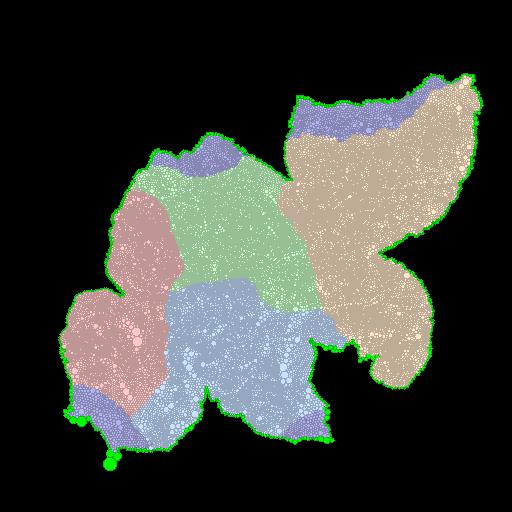
Consider a projection in hyperbolic geometry that maps the cortex gray matter, thus mainly outer layers, to a 2D plane mostly without white matter wiring.
- potentially inverse hyperbolic tangent
atanh()
- consider an iterative process or fractals for the convolutions and/or developmental aspect
- eventually start the other way around, apply tanh() to a 2D surface and compare with an axial view of the brain
- explore instead Monica K. Hurdal's 2001 work on Modeling and Creating Flat Maps of the Human Brain
- the other way around, applying the invert model to a corresponding 2D map
Description of the followed process
- find the 2 brain sides as existing flat rendering
- from WithoutNotesMay11#BrainFlatMap
- http://www.math.fsu.edu/~mhurdal/research/images/visman/vhrfull_er_an.jpg
- convert to SVG http://inkscape.org/doc/tracing/tutorial-tracing.html

- load into ProcessingJS
- done using shape()
- overlay place corresponding areas
- fake vertical stacking of edits via shifted positioning
- drawing a line then adding points instead of rectangles might improve readiblity
- an animation could also add the content of the edit and thus represent the construction of the wiki as a set of successive
- which would only be partly correct since re-organization has been done and this without diff (e.g. moving a page)
See also
 Fabien Benetou's PIM