sometimes giving names to things can help by leading us to focus on some mystery.
It is harmful, though, when naming leads the mind to think that name alone bring meaning close.
Marvin Minsky, TheSocietyOfMind (p27)
Principle
This page list the concepts I thought of without knowing their names. I consequently had to name them even before making a search of their existence.
Consequently I do not "claim" some form of paternity over them and merely list them here in order to more efficiently re-use them and avoid semantic drift.
It mostly illustrate my desire to explore new concepts but also aims at providing a way to see evolution of domains through the history page.
The point is coherent and useful usage, to provide strong affordances in order to go further.
Ideally those concept should become tools, not solely conceptual (descriptive) but directly usable as software or through other "embodiment" (praxis).
Initial drafts
- spatial scaffolding
- responsive programming : extending responsive design to be able to program on the device, any device from eink to mobile phone to device, one is currently using not just to "consume" content, e.g read a Website that is then properly formatted for it, but rather program back that very device
- adversarial dependencies
- using components from third parties with opposite goals to the current project
- this is particularly insidious in software because most of a project is not visible to the final user, just an interface and some branding, yet it can be analyzed through dependencie resolving rather easily
- e.g using work funded and motivated by surveillance capitalism while building a privacy focused tool, e.g Brave relyng on Chromium by Google
- Not only do you depend on it by using it, yes even a fork, but also if your values clash with surveillance capitalism or monopoly abuse then you are basically shooting yourself in the foot.
- Why is it actually a problem? Because even if you rely on a fork, the lead of the project itself remains Google simply by the number of developers it pays to push commit on the main code base. The governance is what matters and even when you piggyback on it and trim the problematic, according to your values, parts you are still promoting an engine with its own idiosyncrasies, features that are not standard, bugs, etc but even more obviously plugin system. By doing that you are not supporting existing alternatives so basically you give more power to Google. (added to https://old.reddit.com/r/degoogle/comments/105e66r/does_using_a_chromium_based_browser_contribute_to/j3bmgxl/ )
- also applies to funding, e.g FOSDEM sponsored by Google
- first used in https://old.reddit.com/r/degoogle/comments/wjylp0/opinions_on_nothing_os/ik4bqfx/
- see also the fable of the scorpio and the frog
- reality chauvinism
- the argumented yet unjustified preference from objective base reality despite being practically unreachable both from our sense and our cognition while ignoring that at least in some situations letting go of reality is actually better, e.g safer, more efficient, more economical
- first used in https://twitter.com/utopiah/status/1548294885563699200
- thought it might be used in Reality+ by Chalmers but the only two mentions of chauvinism are "biological chauvinism" and "skull chauvinism"
- evolutionary mereology
- the process of converging over time toward a structure of information through an evolutionary process of mutation and selection
- for example a one shot fixd ontology defining what are the different concepts related to philosophy would not fit the process. A process of refining that ontology, either by one individual or a group, by splitting a concept in multiple ones or creating groups of concepts by noticing the failure of the past grouping would fit evolutionary mereology as a process.
- in so far as vocabulary respresents an ontology, the acquisition of vocabulary is an interesting proxy to explore the concept
- other examples
- child development and aquisition of language is adptative, i.e a child living in Chile will most likely learn Japanese first
- professional specialization is adaptive, i.e a painter might have names for a multitude of shades of blue while an electronician might have just enough for wiring
- arguably a lot of problems in software development are subject to evolutionary mereology. Naming of variables will change based on progress of the project, refactoring of classes, integration or deletion of libraries, modification of the filesystem, etc are all example where the representation of the problem solved by a program evolves over time thanks to the understanding of developers. Consequently it is not just the ontology of the project that changes but also the relationship between the parts and the number of parts themselves.
- software is also, analoguous to the historical value of the work of Darwin not solely for its novelty but its sheer size, particularly interesting because of the traces. Software development very often takes place in code repository that keep traces of changes.
- software architecture : a piece of software can be design in a myriad of difference ways and usually the first one chosen might not be the best first.
- DevOps or how to organizer servers and their services : the very act of running a service is going to improve our understanding of bottleneck and thus scalability, security and isolation, etc. Consequently our initial choice on how to separate services and servers will refine with experience.
- knowledge management, from personal information management to its social counterpart, their equivalent in the professional world, all evolve over time. It is in fact particularly difficult to maintain one consistent representation over the long run and thus admendements are artefacts of the evolutionary mereological process.
- inspired by WithoutMiracles and TheThingsWeDo both by Gary Cziko on general Darwinism
- see also
- quality theater
- when a corporation prevents competition on its platform by preventing the users to choose a product instead of another. This is deeply problematic because in a capitalit system the market should be making the decision of what makes a product "good" or not. The aggregate decision of consumers to purchase, or not, a product with a certain price signals to the market that it is a good product or not. Preventing product to compete on a platform prevents that decision process.
- examples
- WebKit as a mandatory rendering engine on iOS
- Virtual Desktop streaming banned on Facebook Quest official app store
- arguably trackers that supposedly send back data to improve the quality of the website or applications but seems to be mostly used for profiling for two-sided-markets
- inspired by the Security_theater
 and innovation theater (cf e.g. https://hbr.org/2019/10/why-companies-do-innovation-theater-instead-of-actual-innovation )
- https://twitter.com/utopiah/status/1312669768399433728
- exploratory depth
- statistical success
- that a task have an inherent unpredictable component that can influence the outcome regardless of the efforts put in
- consequently the sole consistent benefit expected should be learning that could lead to a higher chance of success the following attempt still without insuring success
- Biomimetics pace
- how long does humanity required to reproduce an object that evolved without engineer efforts
- one an expect this pace to augment, requiring less and less time as science and technology progress
- it is possible to take a phylogeny perspective but also on ontogeny perspective
- e.g. it took decade (thousands of man-hour) of robotics research efforts to reproduce the behavior of a 2 years old child
- inspired by WithoutNotesNovember11#ConnectorsModularRobots
- see also
- Universal Composer (UC)
- the simplest process (in the AIT sense) that can generate the most encompassing forms of compositions, thus maximizing expressive power
-
|
Gather context, eventually incrementally precisely as it can not be expected to be perfect, and intent.
|
⇒
|
Shortest description that can maximize expressive power by leveraging
- history of solutions in the target domains, ideally phylogenies
- drivers for actuators, including composite of actuators
- ability to map with medium or media would best serve the intent
- organized aesthetics rules
- generalist e.g. the golden ratio
- specialized e.g. cultural
Step by step process
- generating a string of values (linked with Chaitin and Kolgoromov)
- applying selective criteria
- using this values in any interpreter (music, cooking, coding, SDBK, robotics, ...)
- this values have to be interpreted as a process itself, not the final product
- check the result against the expectation, eventually adjust and iterate
|
⇒
|
Maximizing aesthetics/utility/efficiency while minimizing predictability by potential observers. Note that the intent and the observers can be equivalent but do not have to, the iteration of the process can make them match.
|
- Epistemotaxis
- description of the movement of an individual, organism or institution, amongst a body of knowledge
- illustrated by a vector in a geometrical space
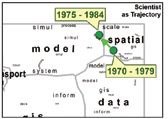
Scientist as Trajectory
cartographic illustration by Andre Skupin
- as foundational perspective one can consider the most important action of epistemotaxis to be a change of cosmology, consciously or not
- changing radically the model of how an organism understands and thus interact with the world it is part of
- it begs questions like, what is the next piece of information I should acquire, what is the next skill I should learn, what is the overall direction and pace of what my society is discovering (e.g. Needs#EpistemologyAndResearchPolicies)
- this wiki with its structure, recipes, visualization, ... is most likely an accompanying tool for (hopefully efficient) epistemotaxis
- note that the process can be hindered in a multitude of ways
- consider the importance of feature selection in machine learning, not just of datasets (e.g. Seedea:Seedea/DATAmatrix
 ) but on what to include and work with and what is missing to generate the best model based on the available resources
- as of December 2010, only mentioned in a page of ElmerGates.com Home Page according to Google
- see also the definition of Epistemic actions page 71 of Supersizing (quoting Kirsh and Maglio)
- http://www.khanacademy.org/exercisedashboard with its graph structure and visualization, as used in MentalExercises, is a perfect example of this concept
- see also Infotaxis as a strategy for searching without gradients, Nature 2007
- inspired by Wikipedia:Trophallaxis discovered in TreeOfKnowledge and Seedea:Content/Newconcepts#Chemotaxis discovered earlier
- Compound information lag
- accumulation of delay one has before adopting a new piece of information or information technology based on his culture/education/economical situation
- if everybody get access to more information but some through their education are better used to process large amount of information thanks to tools, methodology and social network, it is an egalitarian access but in the end it advantages even more those prepared to it
- see also Cognition#EpistemicElitism
- inspired by a discussion on freenode/##philosophy at 10:30 19/10/2010 regarding the egalitarian web rising all the boats
- since we dont all get the same access to the Web, we dont get the same skills to access it, we dont have the same social network to share it with, etc even though this medium and the other to come might not be intrinsically inegalitarian, is the result egalitarian?
- cryptocognition
- the process of using an encoding specifically design to make the process of reversing the thinking pattern difficult to achieve
- discussed in #blinkenshell regarding knowledge management and the desire to keep a job despite efficient scripting, September 2010
- see also Wikipedia:Theory of mind regarding the usefulness of being able to correctly hypothesize what somebody else is thinking
- in particular in conjunctions with Wikipedia:One-way function in order to allow for collaboration without allowing for too much dependency or control
- cf The Need for Cognitive Privacy by Paul Root Wolpe, World Science Festival Video June 2011
- example ?
- mentioned during ParadigmShiftMeetings2011#Conclusion
- see the new field of adversarial machine learning with e.g. UCB J.D. Tygar and Microsoft Benjamin Rubinstein
- algorithmic epistemology
- algorithmic view that epistemology can be most efficiently described as an algorithmic process, a series of steps that once properly carried will inevitably lead to the creation of new knowledge
- most likely synonym to computational epistemology
- working on Innovativ.IT, September 2010
- example ?
- see also
- legislative routing protocol
- your information packet go through specific paths based on the legislation in vigor there
- discussed in #blinkenshell regarding LegislativeRouting and the increasing number of people using VPN especially because of new laws on copyright including in France, September 2010
- "He leveraged the legislative routing protocol through a software overlay using different machines in known geographic locations in order to keep his traffic lawful across several different countries."
- see also Wikipedia:Network neutrality
- Cognitive Drag
- Group theory of mind (aka "gToM")
- extending the theory of mind to a large group of individuals
- gathering and organizing the average cognitive behavior, thus including needs, of a large group of people rather than precisely one (initial understanding of ToM) or even just a few
- since inserted in a competitive system, done economically
- leading thus to an arm race to do so at the lower cost
- Examples
- monetisers of media, according to AmusingOurselvesToDeath those have to make a selection of the content type that the largest audience can consume
- humorists touring around a country to tailor their jokes to a specific social, political and cultural context so that the largest part of their audience can appreciate their material
- LeanStartup by gradually estimating the existence of a market thus probing an increasingly large amount of potential customer to have an increasingly precise model of the mindset of customers
- LeanUX by gradually understand the behavior of users
- Facebook, Google, ... by monetization through reselling usage data
- education in which the teacher is always trying to maximize what the largest group of mine can learn within his or her time constraints, budget constraints, etc... thus leading to an optimization function
- financial system through markets
- script writer for books, TV, movies, etc
- potentially part of a boarder trend
- Inspired by StartupLessonsLearned2011#gToM
- Justification on the name
- previously considered but discarded
generalized as it implies that it could be used on any substrate rather than focusing on the size of the group
networked as it implies the underlying model
recursive as it is by definition recursive
global as it provides no fine grained analysis, either everybody is in or nobody is, in that sense "group" is not perfect either because it is very imprecise, it provides no idea of the scale
distributed as it is not necessarily the case
- See also
Rare abbreviations
I tend to use few abbreviations that are not always popular, this list is just present here despite having been coined earlier because for most readers they can be encountered for the first time.
To do
- add others
- extended homeostasis
- cognitive arbitrage (cf system/encapsulation poster)
- plenty in Cognition
- CognitiveDrag
- cognitive arbitrage (relative to decision making, programming and the ability to use the right function when required to do so while others are not able to, thus providing an opportunity to trade for it)
- Seedea:Seedea/SandIdeabox
- keyconcepts in the livedoc programming repository
- definition of the mind as an economical function
- order by category
- use an automated method to
- find others
- display the number of results in popular search engines
Model
- name
- signification
- context of first usage
- example of usage
- see also
See also
 Fabien Benetou's PIM