This page lists the experiments that I find (despite some difficult considerations) had very important results.
- rat dying by using lever to stimulate pleasure centers rather than eating
- see http://www.iplant.eu/references.html
- from thebacckbox in The Runaway Brain: The Evolution of Human Uniqueness, Christopher Wills, Basic Books 1993
- The story of early development of studies on the genetics of learning in rats is in N. K. Innis, Tolman and Tryon: Early research on the inheritance of the ability to learn, american psychologist 47 (1992): 190-97
- Marian C. Diamond, Enriching Heredity: The impact of the environment on the anatomy of the brain (London: Collier, 1988), traces the detailed studies of enriched and deprived rats."
- The evolution of the brain and the role of brain size are summarized in Harry J. Jerison, Evolution of the Brain and Intelligence (New York: Academic Press, 1973); and H. J. Jerison, Brain Size and the Evolution of Mind, James Arthur lecture on the evolution of the human brain (New York)
- T. W. Deacon, Rethinking mammalian brain evolution, American Zoologist 30 (1990): 692 - 705; and A. J. Rockel, R. W. Hiorns, and T. P. S Powell, The basic uniformity in structure of the neocortex, Brain 103 (1980): 221-44, discuss the organisation of the brain at levels higher than the neuron
- 1992 issue of Scientific American (devoted to Mind and Brain)
- Stanford experiment
- Milgram experiment
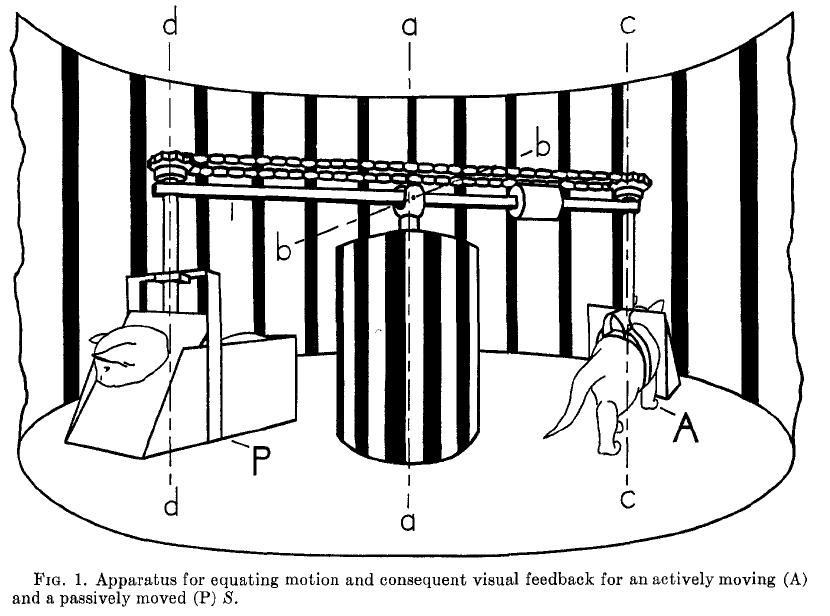
- Held and Hein (1963)
- "There is also developmental evidence that normal vision depends not only on movement of the body relative to the environment, but on self-actuated movement. Held and Hein (1963) performed an experiment in which two kittens were harnessed to a carousel. One of the kittens was harnessed in such a way that it stood firmly on the ground. The other kitten was suspended in the air. As the one kitten walked, both kittens moved in a circle. As a result, they received identical visual stimulation, but only one of them received that stimulation as a result of self-movement. Remarkably (but not surprisingly from an enactive viewpoint) only the self-moving kitten developed normal depth perception (not to mention normal paw-eye coordination). From an enactive standpoint, we can venture an explanation for this: only through self-movement can one test and so learn the relevant patterns of sensorimotor dependence."
- http://www.goes.com/hovancik/exp/kit_caro.htm with picture
- http://www.interdisciplines.org/enaction/papers/1
- Tool-use induces morphological updating of the body schema Current Biology, Volume 19, Issue 12, R478-R479, 23 June 2009
- World Simulation Spring 2008
- Class Project at Kansas State University
- dedicated wiki where most of this content was built by students
- mwesch's Channel for Digital Ethnography, Kansas State University
- YT video with European empires appearing, splitting and changing sizes over time
- Stanford children experiments to categorize reward and time
- Wikipedia:Rouge test

 Fabien Benetou's PIM