(redirected from Fabien.ExtendedLayeredModel)
Principle
Build upon LayeredModel by incorporating its growing LayeredModel#ToDo section and by not being limited to the list structure. The 2 pages are split in order to keep the original idea clear.
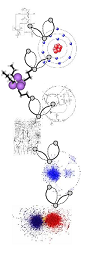
3D sketch on nested layers
3D sketch on controlability (from complex network theory) across layers and the potential impact of tooling
lowest to highest complexity, increase of managed units (each unit on the layer N is constituted of an organization of units from N-1). Note that this does not imply reductionism or downward causality, only different levels of analysis with a continuum of interactions between them.
Regarding reductionism and downward causality, see the Asymmetry section.
(cf LayeredModel#ModelDescriptionStart)
The overarching goal is to facilitate what I consider to be the first usage of a brain: leveraging established correlations for survival (making causal links and using them to secure required resources to live). Yet I believe that doing so efficiently requires proper indexing, i.e. how information is organized to be used in due time. Consequently this page simply aims at providing an index for all information processing.
Note that all layers are physical and are processing information, even if at different speed and scale and though different means.
Result
|
| current model with its locus of analysis
| interaction with the under layer ↑
| interaction with the upper layer ↓
| topology change step (previously routing algorithm)
| possible internal layering
| artificial (non-spontaneous) actuator or "printer"
| cookbooks and ideas
| read/watch material
| attended events
| VR experience
|
|---|
| Information
| Entropy
| no under layer by definition
| ?
|
|
| e.g. physical Turing machine computer, executed software
|
| AncientEpistemology, InformationFeudalism, IntelligentBio, Knowledge and Its Limits, Logicomix, The Mechanical Mind in History, ProgrammingForPeace, ProgrammingTheUniverse, PursuitOfTruth, QuantitativeTrading, TheCodeBook, TheLogicOfScientificDiscovery, TreeOfKnowledge, WithoutMiracles,
|
|
|
| Physics
| Standard model, cosmic microwave background (CMB) radiation
| no under layer by definition
| ?
|
|
| e.g. accelerators, 3d printers
|
|
|
|
|
| Chemistry
| Periodic table, CAS Registry Number
| ?(see physical chemistry)
| ?(see organic chemistry)
|
|
|
|
|
|
|
|
| Biology
| Proteome Interactome Genome Physiome
| homeostasis
| yes by trading energy for sustaining self-descriptive information over time
|
|
| e.g. Organovo NovoGen MMX Bioprinter, DNA synthesis
|
| AnOrchardInvisible, EvolutionaryDynamics, IntelligentBio, Protocells, TheMatingMind, TheRedQueen, TheSelfMadeTapestry, TheThingsWeDo, The Tinkerer's Accomplice, TreeOfKnowledge, WithoutMiracles,
|
|
|
| Neurology
| Connectome
| ?
| yes by extending the requirements of the biology layer (extended homeostasis)
|
|
|
|
|
|
|
|
| Psychology
| list of behaviors
| ?
| yes (extended homeostasis)
|
|
|
|
| The Mathematician's Mind, I am a Strange Loop, QueFaireDeNotreCerveau, Supersizing the Mind, TheDarkSideOfCreativity, TheMatingMind, TheSocietyOfMind, TheThingsWeDo, TheWisdomParadox, TreeOfKnowledge, WithoutMiracles,
|
|
|
| Sociology
| list of social norms
| ?
| yes (extended homeostasis)
|
|
|
|
|
|
|
|
| Politics
| Wikipedia:List of forms of government
| ?
| no upper layer by definition
|
|
|
|
|
|
|
|
| cross every layers
| meta-models studying relations: epistemology, philosophy, mathematics, economy, complex science
| n/a (not causal without being embodied in a layer)
| n/a (not causal without being embodied in a layer)
| e.g. MostImportantEquations
| n/a (consider Wikipedia:Mereology)
| e.g. SKDB/Cookbook#BuildAction but overall very doubtful except practically
| e.g. Cookbook
| e.g. PersonalInformationStream
| e.g. Events
|
|
Structure
|
| current model with its locus of analysis
| interaction with the under layer ↑
| interaction with the upper layer ↓
| topology change step (previously routing algorithm)
| possible internal layering
| artificial (non-spontaneous) actuator or "printer"
| cookbooks and ideas
| read/watch material
| attended events
| VR experience
|
|---|
| layer without upper interaction
| ...
| no under layer by definition
| ...
| ...
| ...
| ...
| ...
| ...
| ...
| ...
|
| layer without upper interaction
| ...
| ...
| ...
| ...
| ...
| ...
| ...
| ...
| ...
| ...
|
| layer with upper interaction (details)
| ...
| ...
| ...
| ...
| ...
| ...
| ...
| ...
| ...
| ...
|
| layer with upper interaction
| ...
| ...
| no upper layer by definition
| ...
| ...
| ...
| ...
| ...
| ...
| ...
|
| cross every layers
| meta-models studying relations: ...
| n/a (not causal without being embodied in a layer)
| n/a (not causal without being embodied in a layer)
| ...
| n/a (consider Wikipedia:Mereology)
| ...
| ...
| ...
| ...
| ...
|
Consequently each layer is assimilated to a network and this network is connected to other layer through either a unidirectional causal link or through a bidirectional causal link.
Fundamentally this can thus be summed over as one single network with different set of rules based on the level of detail one is interested in.
Note that layers without upper or under layers are specific cases and might reflect a lack of current exploration (because of the lack of conceptual models or the cost of tools required). By default a layer should always have the ability to be connected to a layer above and under it.
Details on distinct layers
TradeSelfDescriptionForResources (brown vs white colors)
- perpetually trade available resources (energy) to
- maintain their agency by organizing units from upper layers
- eventually optimize their own organization in order to do so
See also "It is this interplay -this back-and-forth between information and energy- that makes the universe compute." (p36, Chapter 3 of Programming The Universe) and "I suggest thinking about the world not simply as a machine, but as a machine that processes information. In this paradigm, there are two primary quantities, energy and information, standing on an equal footing and playing off each other." (p115, Chapter 7 ibid)
Cross every layers (gray color)
- factored-out to remove clutter as, if left in each level it would add a lot of repetitions
- depending in the usage, the visualization items can be expanded back in every layers
- structure in this layer could also be added, for example from the more generalist to the more specific e.g. mathematics as a closure to complexity as a closure to economy, etc
See Adler's distinction between first-order and second-order knowledge.
Visualization
Interactive folded view
- 1 layer synthesis : (to name)
Note that this visualization would probably be facilitated by applying Structure to a dedicated group with its main page with a page list with a page for each layer and a template page.
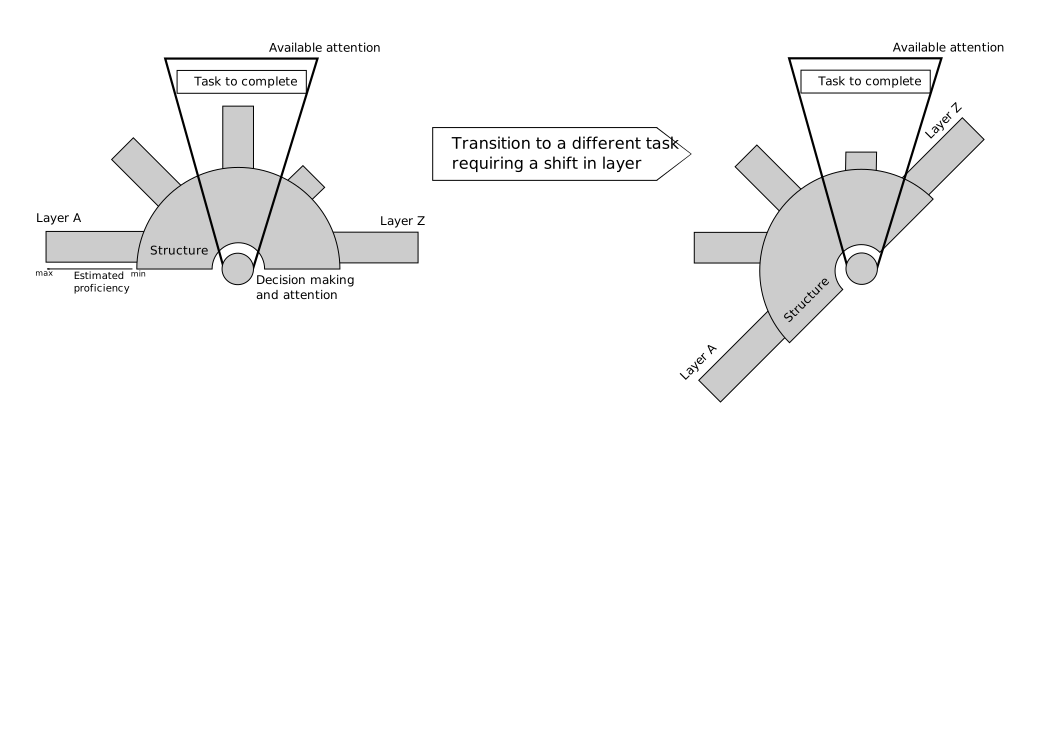
User-centered curve
- each layer could be represented by a column centered around the self
- the high would represent the assessed level of knowledge
- each task required to be done by the user would then aligned the appropriate layer with the 12 o'clock position and with the appropriate level of zoom, displaying more or less neighboring layers
In this simplistic drawing, "Structure" would represent this very page, in particular from ExtendedLayeredModel#ModelStart to ExtendedLayeredModel#ModelEnd. The wiki overall, and even less knowledge outside of it, is not represented.
Note that another dimension (e.g. vertical if we imagine here the drawing being on the horizontal plane) dimension could use to represent time, how the models evolve through time and, hopefully, are improved. One could also imagine his own models and tools as presented here as projected on a transparent half-sphere through which he sees the world.
Pedagogically, one could imagine a transparent sheet at the end of each learning book that a student would put and see his own diagram evolve over time. One could also hold a repository of tasks to complete associated with a layer and share it with others so that next time somebody is trying to achieve a similar task, the curve get oriented accordingly, either directly or as an average.
Structure
|
| current model with its locus of analysis
| interaction with the under layer ↑
| interaction with the upper layer ↓
| topology change step (previously routing algorithm)
| possible internal layering
| artificial (non-spontaneous) actuator or "printer"
| cookbooks and ideas
| read/watch material
| attended events
| VR experience
|
|---|
| layer without upper interaction
| ...
| no under layer by definition
| ...
| ...
| ...
| ...
| ...
| ...
| ...
|
| layer without upper interaction
| ...
| ...
| ...
| ...
| ...
| ...
| ...
| ...
| ...
|
| layer with upper interaction (details)
| ...
| ...
| ...
| ...
| ...
| ...
| ...
| ...
| ...
|
| layer with upper interaction
| ...
| ...
| no upper layer by definition
| ...
| ...
| ...
| ...
| ...
| ...
|
| cross every layers
| meta-models studying relations: ...
| n/a (not causal without being embodied in a layer)
| n/a (not causal without being embodied in a layer)
| ...
| n/a (consider Wikipedia:Mereology)
| ...
| ...
| ...
| ...
|
Asymmetry
Now moved to its dedicated page StructuralInformationAsymmetries
See also
To do
- integrate
- LayeredModel#ToDo
- EpistemologicalModel to facilitate routing/traversing in and across layer, in particular abstract ones on relations (e.g. mathematics, philosophy, economy)
- Seedea:Seedea/BackEnd
 for generating new models
- supported by Seedea:Research/PhylogeneticFlowProgramming (ΦFP) to handle evolution over time
- e.g. Wikipedia:Category:History of ideas and timelines of model for each layer
- MyBeliefs especially to check for consistency
- VisualBookShelfByCategory
- adapted for
- Biology separation through color separation
- LayeredModel#AssociatedModels through additional column
- Seedea:Seedea/InnovationChain and Cookbook#BuildAction for "printing" or producing through additional column
- MostImportantEquations through additional column
- cf also array schema written in a paper notebook before September 2010
- consider it as the entry page of the wiki to
- be more encompassing and
- have more feedback on it
- but then since the table is large
- provide a dedicated skin (e.g. no menu or borders)
- fold some parts and unfold by overlay or click
- be more compact, thus useful without being displayed
- use only a line of Structure as potentially the fundamental unit of study from EpistemologicalModel and Seedea:Research/PhylogeneticFlowProgramming
- providing the most summed-up view
- allowing to expand each line to more lines from the "possible internal layering" column
- facilitate interactions thus personal involvement thus better understanding (at least according to constructivism)
- consider a better structure to allow direct inclusion in this page in an even more distributed fashion
- pages in groups
- e.g. Content, Cookbook, ReadingNotes
- sections in pages
- e.g. Content/Cosmology#CurrentModel
- improve the column models by rejecting lists instead of connected network with its set of rules
- if there is an actuator, where is the sensory equivalent to respect TreeOfKnowledge?
- modelize my own crawling/browsing behavior
- see also the discussion with nicktick on freenode/##pim at 14:20 23/21/2010 regarding search engines and crawling techniques as a potential equivalent for the information layer
- News
- list for of each layer
- their network model
- potential source for datasets
- e.g. table 1 of WithoutNotesMay11#TamingComplexity or tables in Barabási's 2001 review article
- computational equivalent (e.g. Wikipedia:Computational sociology)
- quantitative equivalent (e.g. Wikipedia:Scientometrics, Wikipedia:Econometrics)
- sum-up as a network of models
- with layer restrictions but defined rather by usage than by intrinsic property
- beside eventually the total number of "nodes" involved
- data for a model as a simplification of the output of another model
- consider balance between local optima and general optimum
- i.e. how the upper or under layer own homeostasis influences back and thus how it could lead to transitions more favorable to itself then to the other layers
- Wikipedia:Integrative level
- Integrative Levels Classification "Theory of integrative levels claims that the natural world is organized in a series of levels of increasing complexity: from physical particles and molecules, through biological structures, to the most sophisticated products of human thought."
- consider unifying layers by running simulations constrained by the models of two successive layers
- them algorithmically tinker the unifying model until it match both and at the minimum computational cost
- repeat for every layers
- focusing only on the "most exciting problem", i.e. the longest chain of events through the entire list of layers e.g. how political thoughts are generated out of matter is probably masking other interesting problems that this model could help to study
- e.g. how does the pleasure of taste came out of chemicals like salt, sugar, fat or spices used during cooking (especially interesting for a cook)
- Stanford Large Network Dataset Collection
- The Emerging Science of Connected Networks, arXiv blog for MIT Technology Review 2012
- read in March 2012
- explore Dynamics of Multi-Level Complex Systems (DyM-CS)
- consider description format per layer
- starting with the most popular ones for remote services e.g
- Gerber files in electronics
- FPGA design blocks
- BioBricks with iGem for biology, especially synthetic biology
- GCode or STL for 3D printing
- .dxf for CNC
- consider links between layers, e.g can you generate an STL from a Gerber file?
 Fabien Benetou's PIM