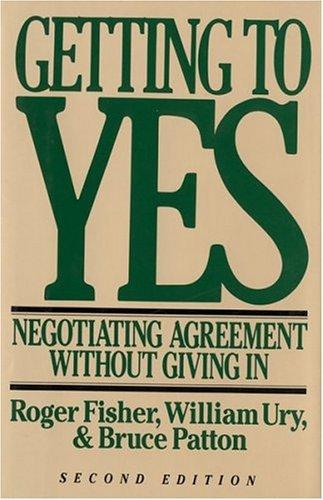
Getting to yes: negotiating agreement without giving in by Roger Fisher, William Ury, Bruce Patton - ISBN 0395631246 - Houghton Mifflin Harcourt 1991
Motivation
Holding the belief that negotiation is not limited to middle-eastern conflicts but rather a daily life situation thus a skill to acquire.
Pre-reading model
Draw a schema (using PmGraphViz or another solution) of the situation of the area in the studied domain before having read the book.
Reading
- BATNA (Best Alternative To a Negotiated Agreement)
- Four steps method
- Separate the people from the problem
- Focus on interests, not positions
- Invent options for mutual gain
- Insist on using objective criteria
(to re-read)
See also
Overall remarks and questions
- understanding your own goal and the goal of the person you are dealing with is fundamental
- it is all, once again, about how well you gathered information ahead of the negotiation process itself
- the goal is not to give in or force the outcome, the goal is to actually have a mutually positive outcome (if you wish to reiterate collaboration)
- see game theory and the repeated prisoner dilemma
- go beyond what is already on the table
- a bit like what is proposed with Blue Ocean Strategy
- note that visualizing Venn diagrams can help
- The brain during mediation by François Bogacz and Jeremy Lack, Convirgente/Altenburger May 2010
- based on David Rock SCARF model
Synthesis
So in the end, it was about X and was based on Y.
Critics
Point A, B and C are debatable because of e, f and j.
Vocabulary
(:new_vocabulary_start:)
new_word
(:new_vocabulary_end:)
Post-reading model
Draw a schema (using PmGraphViz or another solution) of the situation of the area in the studied domain after having read the book. Link it to the pre-reading model and align the two to help easy comparison.
Categories
Back to the Menu
Other read books linking to the GettingToYes page :
Back to the Menu
 Fabien Benetou's PIM